

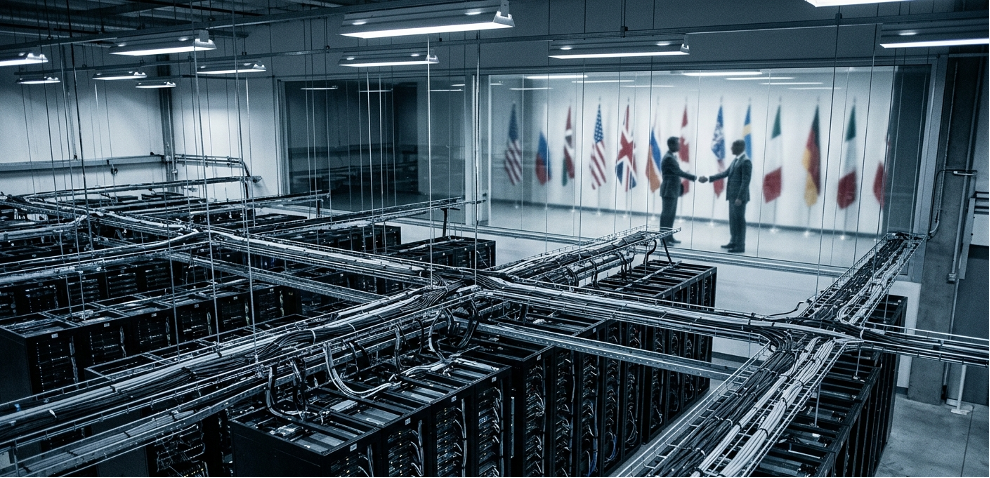
Data residency tells you where information is stored. Operational control tells you who can disable, audit, patch, or throttle the system that processes it
FUTURECRAFT | TECHNOLOGY & MARKETS
ARSSH KUMAR
On 15 May 2026, at a ceremony witnessed by Prime Minister Narendra Modi and UAE President Sheikh Mohamed bin Zayed Al Nahyan, India’s Foreign Secretary and the CEO of Abu Dhabi’s G42 formalised the commercial terms for Condor Galaxy India. The system will deliver eight exaflops of AI compute, making it one of the most powerful AI clusters on Indian soil. The government described it as a milestone in sovereign AI.
That word deserves some examination.
India’s sovereign AI agenda has real substance behind it. The IndiaAI Mission has allocated over Rs 10,372 crore to build domestic compute capacity. Sarvam AI and BharatGen have launched foundation models trained on Indian data. The Bhashini platform migrated to indigenous infrastructure in February 2026. These are not trivial achievements. But the infrastructure being celebrated as sovereign at the Abu Dhabi signing ceremony is installed, operated, and maintained by a firm chaired by the UAE’s national security adviser and backed by Abu Dhabi’s state sovereign wealth fund, Mubadala. The data will sit within Indian borders. The company running the hardware will not.
What sovereignty actually requires
The government’s standard claim is that data residency equals sovereignty. As long as data does not cross the border, the argument goes, the infrastructure qualifies as national. This framing collapses an important distinction. Data residency tells you where information is stored. Operational control tells you who can disable, audit, patch, or throttle the system that processes it.
G42 is not an independent commercial firm. Its chairman, Sheikh Tahnoon bin Zayed Al Nahyan, is the UAE’s national security adviser and a brother of the president. Mubadala, Abu Dhabi’s sovereign wealth fund, holds a stake in the company. Under the framework formalised on 15 May, a G42 unit will handle installation, operations, and maintenance of the supercomputer. This means the operational control layer of India’s most powerful AI cluster reports, ultimately, to a foreign state apparatus.
A legal concept worth noting here is what scholars of AI governance call remote disablement: a foreign vendor, under compulsion from its home government or pursuant to contractual terms, can restrict or disable hardware deployed on Indian territory. A system whose inferential capacity runs on infrastructure subject to foreign jurisdiction is not sovereign in any meaningful operational sense. It is leased.
The hardware layer underneath
The G42 issue is the most visible part of a deeper structural problem. India’s broader AI infrastructure is built almost entirely on foreign silicon. The IndiaAI Mission has onboarded 38,000 Nvidia GPUs, available at Rs 65 per GPU-hour. Yotta’s Shakti Cloud, billed as sovereign AI cloud infrastructure, is adding 20,736 Nvidia Blackwell Ultra GPUs at its Greater Noida campus. Reliance’s one-gigawatt AI data centre in Gujarat is being built on Blackwell architecture. L&T is constructing gigawatt-scale AI factory infrastructure in Chennai and Mumbai, also on Nvidia systems.
Every one of these chips is subject to US export licensing. Under the Biden administration’s AI Diffusion framework, India was placed in Tier 2 with a cumulative cap equivalent to roughly 50,000 H100-class GPUs through 2027. For context: a single American hyperscaler deploys more than that for a single project. India’s entire two-year allocation is a rounding error in the US domestic AI buildout. The Trump administration rolled back the formal diffusion rules in 2025, but the underlying architecture of export control authority remains intact. Washington can reinstate access restrictions. The hardware layer is a foreign chokepoint dressed in Indian branding.
The G42 trust problem
G42’s recent history complicates the picture further. In January 2024, the US House Select Committee on the Chinese Communist Party wrote to the Commerce Secretary calling for an investigation into G42’s ties to Huawei, BGI Genomics, and entities linked to the PRC’s military-civil fusion programme. The committee noted that G42’s CEO, Peng Xiao, was affiliated with an expansive network of UAE and China-based companies developing dual-use technologies. G42 subsequently divested its Chinese holdings and accepted US-imposed constraints as a condition of Microsoft’s $1.5 billion investment.
India is now deploying the same firm as the operator of its national AI supercomputer. That G42 cleaned up its China entanglements to access American capital is not the same as saying those entanglements are irrelevant to India’s strategic calculus. The company that holds the maintenance contract on Condor Galaxy India is the same company that, two years ago, was under active US Congressional pressure over its ties to Chinese military-linked entities. India’s security establishment is presumably aware of this. Whether it has been adequately weighed against the compute access on offer is another question.
The steelman: why India may have no choice
The counter-argument is serious and should not be dismissed. India’s domestic chip manufacturing capacity does not exist yet. Tata’s Dholera fab, the country’s first semiconductor fabrication facility, received its Special Economic Zone notification in April 2026 and is targeting trial production at 28 nanometre nodes by late 2026. The frontier AI chips that matter for model training operate at three to four nanometres. The gap between where Indian silicon manufacturing starts and where it needs to be for AI sovereignty is not a few years; it is a decade or more of sustained investment and industrial development.
CFR has argued that for countries like India, the more urgent risk is not dependency per se but being locked out of AI’s benefits entirely while the technology compounds elsewhere. On that framing, the G42 deal and the Nvidia infrastructure buildout are the pragmatic path: take the compute now, build domestic capability in parallel, and accept the dependency as a transitional cost.
That argument holds for civilian AI applications. It is harder to sustain when the infrastructure in question is being positioned as the foundation of India’s national AI security posture, with the government using sovereignty language at the signing ceremony. The word sovereignty implies a degree of control that the current arrangements do not deliver. Using it to describe infrastructure you cannot unilaterally disable, audit, or replace without a foreign company’s cooperation is a political claim, not a technical one.
Bottom Line
India needs the compute. The G42 deal is probably necessary given the alternatives. The Nvidia buildout is unavoidable at current speeds. None of that requires calling it sovereignty. The problem is not the dependency; middle powers have always operated with dependencies. The problem is that the vocabulary of self-reliance is being used to describe arrangements that preserve the same structural vulnerabilities it claims to solve.
When the next crisis arrives, whether geopolitical, commercial, or technical, the question will not be where the data is stored. It will be who controls the infrastructure running the models that matter. On that question, the Condor Galaxy India ceremony offered a photo opportunity, not an answer.
(The Author studies Computer Science and Artificial Intelligence at Rutgers University, New Jersey, USA. He is interested in emerging technologies and innovation, and can be reached on LinkedIn at @arssh-kumar14)