

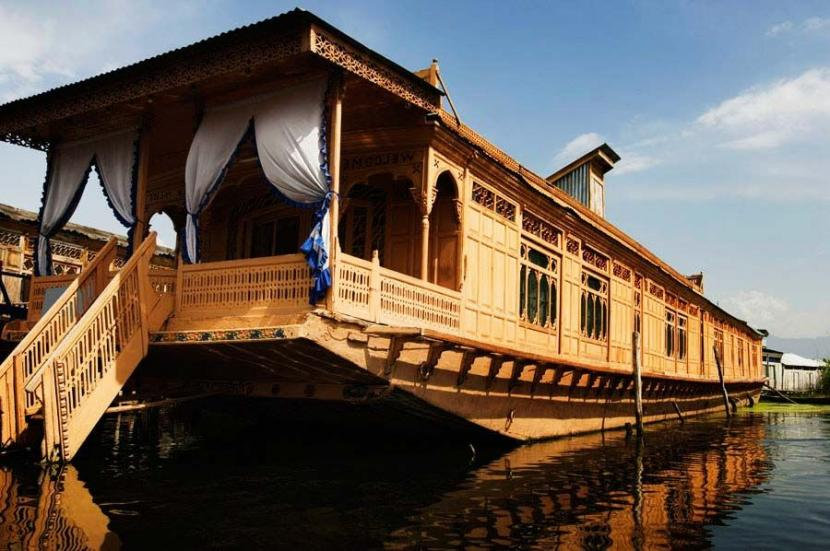
To allow this craft to die is to amputate a part of our own story
DR AZHAR AYAZ SHAH
An inheritance we are letting sink
For more than a century, Kashmir’s houseboats have floated on Dal and Nigeen lakes as silent witnesses to our history – from Dogra rule to the turmoil of the 1990s, from the first trickle of foreign tourists to the selfie generation. They are not just ornamental lodging for visitors; they are moving museums of a rare craft, the living rooms of our memory. Yet today, the art that created them is fading before our eyes.
The gradual disappearance of houseboat making is not a romantic exaggeration. It is a harsh reality shaped by environmental degradation, confused regulations, economic distress, and official apathy. What we are watching is not only the decline of a tourist product but the erosion of a unique cultural technology that belongs to Kashmir and nowhere else in the world.
A craft born of ingenuity and constraint
The Kashmiri houseboat emerged from a convergence of geography and politics. During the Dogra rule, non-local officers were not allowed to own land in the Valley. So, to host British officials and travellers, local craftsmen innovated: they brought the home to the water. These were not crude barges. They were hand-crafted wooden marvels that combined the structural knowledge of boat builders with the aesthetic finesse of woodcarvers from Zainakadal and Zadibal.
Every plank of deodar was chosen with care. Every joint was made by hand and sealed with traditional materials, long before industrial resins arrived. The elegant khatamband ceilings, the carved walnut panels, the latticed windows – all of these were the signature of a shared ecosystem of artisans: boat makers, carpenters, carvers, upholsterers, even copper artisans whose samovars completed the experience.
This craft was never merely about construction; it was about adaptation. The houseboat was designed to respond to water levels, to the Valley’s harsh winter, to the social needs of extended Kashmiri families and foreign guests. A finished houseboat embodied generations of accumulated knowledge – much of it unwritten, passed from master to apprentice, from father to son.
Today, that chain is breaking.
From pride to precarious livelihood
Talk to any remaining houseboat maker on the banks of Dal, and a similar story emerges. Where once there were long waiting lists and advance bookings to build or renovate houseboats, now there are sporadic orders and growing debts. A traditional houseboat takes months to a year to build, requires expensive seasoned timber, and demands a high level of skill. But the returns are no longer commensurate with the labour.
At the same time, younger generations are refusing to enter the profession. They see their fathers struggling with license issues, court notices, and an uncertain future. They compare their own modest earnings with what a basic job in the private sector or outside the state can provide. Faced with such an unequal bargain, why would a young Kashmiri choose to plane wood on the lake in the bitter cold when they could sit in an office in Delhi, Dubai, or even Srinagar’s emerging corporate spaces?
The emotional cost of this exodus is visible on the faces of ageing craftsmen. Many of them speak of their work with great pride. Yet they also admit that when they look around in their workshops, they no longer see apprentices. They see empty spaces, idle tools, and the fear that once they are gone, the knowledge will die with them.
Environmental crisis and regulatory confusion
No serious discussion of houseboats can ignore the ecologically fragile state of our water bodies. Dal Lake has been shrinking for decades under the pressure of encroachments, sewage, and unplanned development. In response, authorities have often treated houseboats as convenient scapegoats – highly visible structures that can be easily targeted while more powerful polluters continue largely unchecked.
Yes, houseboats contribute to the lake’s ecological load, especially when sewage management is not modernised. But they are a small part of a much larger problem. For years, policy has oscillated between eviction threats, demolition drives, and vague promises of rehabilitation or infrastructure upgrades. Licenses have been frozen, new houseboats have been effectively banned, and repairs have become mired in permissions and bureaucratic uncertainty.
The result is a perverse situation: owners are not allowed to build new houseboats or substantially upgrade old ones, yet they are blamed when dilapidated structures sink or leak pollutants. Craftsmen who could have been employed in retrofitting houseboats with modern, eco-friendly technologies are instead sitting idle, while the narrative of “houseboats as environmental villains” gains ground.
A more balanced policy would recognise houseboats as heritage assets and regulate them accordingly. Instead, we largely have a regime of fear and confusion. The government talks of preserving the lake and reviving tourism, but on the ground, the people who embody both the houseboat makers and owners are left to navigate an impossible maze of notices, surveys, and shifting guidelines.
Tourism without soul
The irony could not be sharper. At every tourism fair, in every promotional clip, Kashmir is marketed with the same images: a shikara gliding over still waters, the silhouette of houseboats at sunrise, the reflection of snow peaks in the lake. These visuals have become shorthand for the Valley itself.
Yet behind this marketing gloss lies a painful contradiction. We are aggressively selling an icon whose foundations are eroding. International visitors still dream of “staying on a houseboat” because it promises an authenticity that concrete hotels can never match. But if the art of making and maintaining those houseboats dies, what will be left? Plastic replicas? Floating resorts with no roots in local culture? A tourism experience without soul?
Sustainable tourism does not mean stripping away everything that makes a place unique in the name of environmental purity. It means investing in the very crafts and communities that give a destination its character, while modernising practices to reduce harm. In the case of houseboats, this could mean government-backed schemes for sewage treatment units, subsidies for eco-friendly materials, and heritage-based branding that commands better prices in the market.
Instead of such forward-looking interventions, we mostly see neglect. When policy treats houseboats as a problem to be managed rather than an asset to be nurtured, it inevitably discourages the next generation of craftsmen.
An unacknowledged cultural technology
Much is written and spoken about Kashmiri handicrafts: pashmina, carpets, papier-mâché, and walnut carving. These receive geographical indication tags, craft clusters, and export promotion. But the art of houseboat making rarely features in these conversations. It falls between categories: too functional to be seen as pure art, too artisanal to be treated as simple construction.
This blind spot is dangerous. A houseboat is not just a building on water; it is a sophisticated cultural technology that encodes our understanding of climate, water, and social life. It’s very form, low sloping roofs, deep verandas, intricate ventilation, reflects adaptation to our environment. The way weight is distributed, the way the hull is joined, the way the structure is anchored, yet allowed to move – all of this is the outcome of centuries of experimentation.
If this knowledge disappears, it cannot be easily revived from textbooks or YouTube videos. You cannot learn houseboat making from a manual the way you can learn basic carpentry. You must stand beside a master on the lake, feel the timber, listen to the creak of the planks, and understand the behaviour of wood in water and frost. When we lose that chain of learning, we are not simply losing nostalgia; we are losing hard-won, place-specific intelligence about how to live with our environment.
What must be done – and who must act
If we accept that the art of houseboat making is in danger, the obvious question is: what can be done? The answers are not mysterious. They require political will, institutional support, and community participation.
Recognise houseboats as heritage
The first step is official recognition. Houseboats should be declared a protected cultural asset – not as museum pieces, but as living heritage. This would open the door to targeted schemes, conservation funds, and technical assistance.
Support eco-friendly modernisation
Instead of freezing new construction and making repairs a nightmare, authorities should incentivise environmentally sound upgrading. Provide subsidies or low-interest loans for sewage treatment units, safer materials, and structural improvements. Train craftsmen in blending traditional techniques with modern engineering.
Create a formal apprenticeship and documentation programme
Colleges of engineering and architecture in Kashmir should collaborate with master houseboat builders to document their knowledge – not to replace them, but to support them. Registered apprenticeship programmes, stipends for young learners, and integration of houseboat design into academic curricula can make the craft a viable career path again.
Give houseboat makers a voice in policy
For too long, decisions about Dal and Nigeen have been taken in conference rooms away from the communities that depend on them. Any serious policy on lake conservation and tourism must include representation from houseboat makers and owners. They are not obstacles to the lake’s revival; they are potential allies.
Shift the tourism narrative
If the government can market shikaras and houseboats to attract visitors, it can also use that same platform to highlight the story of the craftsmen. Curated experiences, guided tours of workshops, and heritage labels can increase the perceived value of staying on a traditionally built houseboat and thus increase the earnings of those who build and maintain them.
Will we let them vanish in silence?
The tragedy of Kashmir’s houseboats is not only that they are decaying; it is that they are decaying quietly. There is no public outcry when a houseboat sinks. There are no headlines when another master craftsman dies without an apprentice. We notice only when a striking photograph circulates on social media – a half-submerged structure, tilted like a broken memory.
If we continue on this path, a time will come when the images used to sell Kashmir will be little more than archival footage. Tourists will still come for the mountains and the snow, but the intimate, floating world of carved wood and warm lamps on the water will be gone.
The fading art of houseboat making is a test of our priorities as a society. Do we see culture only as a commodity, useful as long as it fills hotel rooms and Instagram feeds? Or do we see it as a living inheritance that connects us to our past and shapes our identity in the present?
Kashmir cannot afford another silent extinction. To allow this craft to die is to amputate a part of our own story. The choice before us is stark: either we act now with imagination, respect, and urgency, or we watch, from the shore, as one of our most beautiful traditions slowly sinks beneath the surface, never to rise again.
(The Author is a social activist, educationist and freelance writer)