

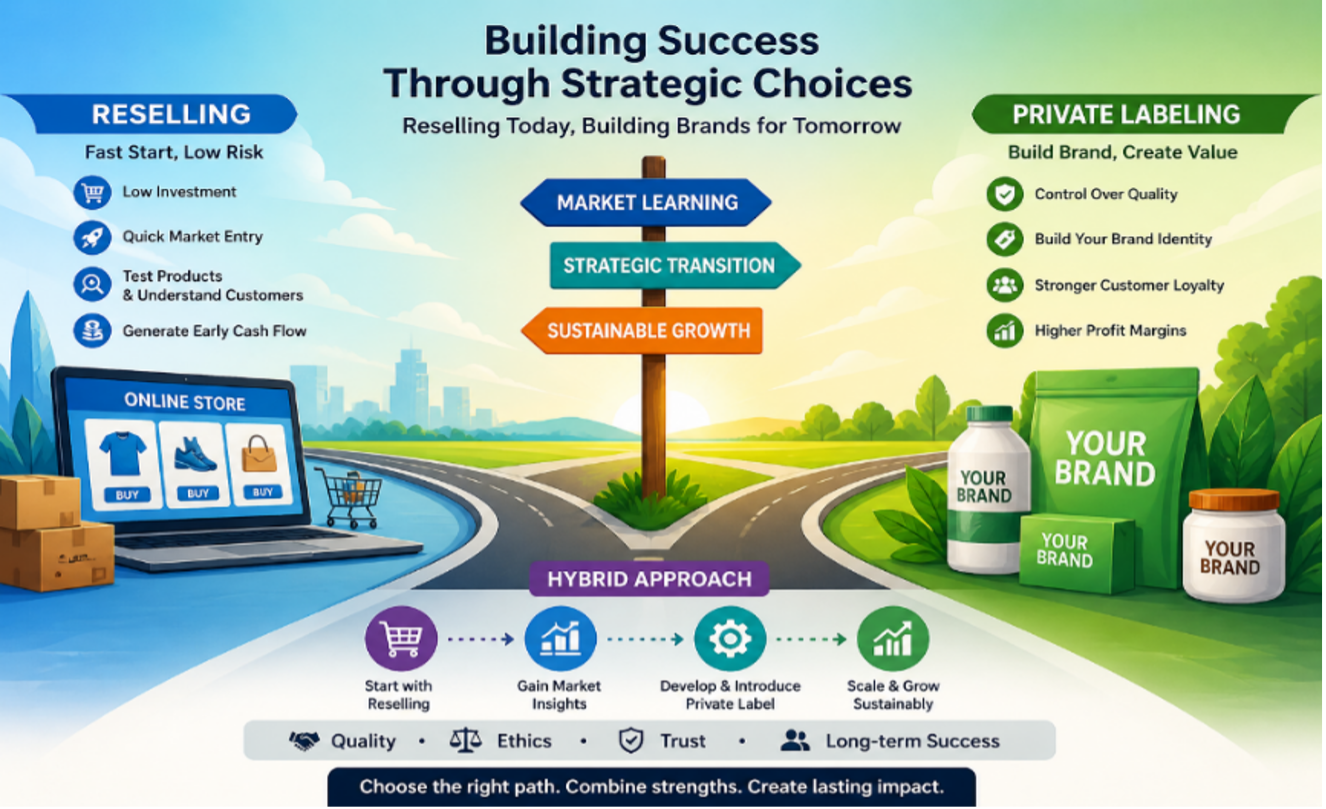
The choice between reselling and private labelling is not merely operational but deeply strategic, shaped by a firm’s resources, risk appetite, and long-term vision
DR. SHAHID AMIN
In today’s dynamic, highly competitive business environment, entrepreneurs and businesses are continually exploring efficient models to enter and expand in markets. Among the prominent approaches are reselling and private labelling, both of which have gained significant traction with the rapid growth of e-commerce and digital marketplaces.
While these models enable firms to sell products without necessarily engaging in manufacturing, they differ fundamentally in terms of control, investment requirements, branding opportunities, and long-term value creation. A clear understanding of these differences is essential for informed strategic decision-making.
Understanding Reselling- It is one of the simplest and most accessible business models. It involves purchasing products from manufacturers, wholesalers, or distributors and selling them directly to consumers at a markup, which represents the reseller’s profit margin. In this model, the reseller does not significantly alter the product and typically markets it under the original brand name. For instance, selling branded products such as smartphones, apparel, or consumer goods falls within this category.
The primary appeal of reselling lies in its low entry barriers. Entrepreneurs can initiate operations with minimal capital investment, often utilising online marketplaces and social media platforms to reach a wide customer base. Since the products are already established in the market, resellers benefit from existing brand recognition, reputation, and customer trust. Furthermore, operational complexities remain limited, as there is no requirement for product design, manufacturing, or extensive quality assurance processes.
However, despite its accessibility, reselling presents several limitations. The market is often characterised by intense competition, with multiple sellers offering identical products. This leads to price-based competition, reduced profit margins, and minimal scope for differentiation. Additionally, resellers are highly dependent on suppliers for pricing, inventory availability, and product quality, making the business vulnerable to external uncertainties. Consequently, reselling is generally considered a short- to medium-term strategy rather than a sustainable long-term growth model.
Amazon India and Flipkart operate as marketplaces where sellers offer branded products such as electronics, books, and apparel, leveraging existing brand value and the platforms’ reach. Meesho focuses on social commerce, enabling individuals—especially small entrepreneurs—to resell products through WhatsApp, Facebook, and Instagram with minimal investment.
Snapdeal functions as a value-oriented marketplace, allowing sellers to offer both branded and unbranded goods across categories. IndiaMART serves as a B2B platform where traders and wholesalers supply industrial products, raw materials, and consumer goods to businesses. Offline retail follows a similar model. Stores like Reliance Smart Bazaar and Reliance Digital sell branded items such as Coca-Cola beverages or Samsung phones. Likewise, selling packaged goods like Maggi or Surf Excel at DMart is an example of reselling.
Understanding Private Labelling- In contrast, private labelling involves sourcing generic or unbranded products from manufacturers and selling them under a firm’s own brand name. Businesses often customise product features, packaging, and branding elements to create a unique identity in the marketplace. This model offers significantly greater control over both the product and the brand.
By establishing a distinct market presence, firms can differentiate themselves in competitive environments, foster customer loyalty, and command higher profit margins. Private labelling also enables businesses to tailor products according to specific customer needs and preferences, thereby enhancing overall value creation.
Nevertheless, private labelling requires a higher level of investment and strategic commitment. Entrepreneurs must allocate resources to branding, packaging design, marketing, and, sometimes, product development. In addition, risks related to inventory management, quality assurance, and supplier reliability must be carefully managed. Unlike reselling, where demand can be tested quickly, private labelling involves longer lead times and greater financial exposure, making it a more complex but potentially rewarding approach.
Reliance Retail’s grocery businesses primarily market products of third-party FMCG players; they also sell in-house brands. Reliance Retail owns names such as Snactac (snacks), Puric (hygiene), Enzo (laundry), Glimmer (beauty), and Get Real (personal care), among other private labels in apparel, footwear, and electronics, which were launched over the years as part of its private label push into retail.
Similarly, retail formats like Star Bazaar by the Tata Group sell in-house products such as Klia (hygiene), Fabsta (food/snacks), and Skye (personal care) under their own store brands, reflecting a private-label strategy. Private Label Brands Fresho and BB Royal are the private labels of BigBasket, under which it offers various products to consumers. Fresho offers everything fresh, including milk, bread, cheese, eggs, fruits, and vegetables.
In e-commerce, Amazon sells products under its own brand, AmazonBasics, which is a classic example of private labelling. Amazon Basics, one of Amazon’s most notable private labels, was created to provide customers with high-quality products at competitive prices. Launched in 2009, Amazon Basics offers a wide range of everyday items. Likewise, Flipkart’s in-house brands, such as MarQ, represent private labels developed and sold exclusively on its platform.
Insights from Research- Empirical research further strengthens the understanding of these business models. A 2017 study examining the impact of brand image, product quality, and self-efficacy on purchase decisions regarding private-label rights (PLR) products found that product quality plays a significant role in shaping consumer behaviour. The study concluded that maintaining and enhancing product quality leads to a more positive perception of private label products, thereby increasing consumers’ willingness to try and purchase them.
Another study conducted in 2022 explored the strategic decisions of a small manufacturer entering a market dominated by a larger competitor. Due to the lack of technological superiority, the small firm had to choose between producing imitation products (copycats) and engaging in private labelling. The findings revealed that consumer purchasing decisions are influenced not only by price but also by product quality, brand value, and consumer patience. The analysis further suggested a dynamic strategic pattern.
As the production costs of genuine products increase, the small manufacturer initially adopts a passive strategy of producing copycats, then shifts to an active acceptance strategy by engaging in private labelling, and eventually moves to an active rejection strategy, reverting to copycat production under changing market conditions. This highlights the adaptive and flexible nature of small firms in responding to cost pressures and competitive dynamics.
A 2022 research argued that Indian retailers introduce private labels as a price-based strategy to offer lower-priced alternatives and capture a share of the branded goods market; however, this approach often fails to deliver the desired outcomes, as established brands already command a significantly higher market share, supported by strong consumer trust, brand equity, and extensive distribution networks, thereby making effective competition for private labels particularly challenging.
Strategic Considerations- The choice between reselling and private labelling is not merely operational but deeply strategic, shaped by a firm’s resources, risk appetite, and long-term vision. Reselling offers an accessible entry point, allowing businesses to test markets, understand customer preferences, and generate early cash flows with minimal investment.
However, its inherent limitations in differentiation and margin expansion necessitate a gradual shift toward more value-driven approaches. Private labelling, in this regard, provides greater control over product quality, branding, and customer experience, enabling firms to build stronger market positions and long-term brand equity.
Rather than viewing these models as mutually exclusive, businesses can benefit from adopting a hybrid or phased strategy—leveraging reselling for market learning and transitioning toward private labelling for sustainable growth. This integrated approach allows firms to balance risk with opportunity while responding dynamically to market conditions.
Ultimately, long-term success depends not only on the chosen model but also on a firm’s ability to maintain quality, uphold ethical standards, and build customer trust. At the same time, ethical considerations play a crucial role in both approaches, influencing trust, transparency, and long-term success. These aspects will be explored in depth in the next article.
(The Author is Associate Professor, Department of Management, President Institution’s Innovation Council, ITM Gwalior and an IIMA (FDP) Alumnus. He is a certified Business Consultant by AIMA and can be reached at: dr.shahidamin15@gmail.com)