

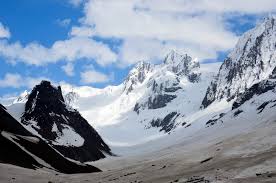
KU study warns glacier retreat can destabilise river systems, hydropower across South Asia
Abid Bashir
Srinagar, Jun 03: Kashmir’s glaciers, which have fed rivers and supported life for centuries, are now in trouble. A new study by Kashmir University scientists warns that climate change is breaking down one of Asia’s most important freshwater reserves.
The study by KU researchers has raised serious concerns over the future of glacier-fed rivers originating in the Kashmir Himalaya, describing the region as a crucial component of Asia’s “Water Tower” — the vast high-altitude ice reserve that supports billions of people downstream.
The study warns that accelerating glacier retreat, rising temperatures and changing precipitation patterns could significantly diminish streamflow in the transboundary rivers flowing from the Upper Indus Basin, one of the most strategically important river systems in South Asia.
“The findings will contribute to a better understanding of glacier-climate interactions and their implications for future water availability in the Kashmir Himalaya,” the researchers noted in the study, underlining the urgency of monitoring glacier evolution in the region.
For decades, the glaciers of Kashmir and the greater Himalayan arc have acted as natural water storage systems, gradually releasing meltwater into rivers that sustain agriculture, hydropower generation, drinking water supplies and ecosystems across India and Pakistan.
But scientists say this delicate balance is beginning to shift. According to the study, ongoing climate change is expected to “considerably alter the seasonality and composition of future runoff,” affecting the hydrological regime of the Upper Indus Basin and increasing the vulnerability of communities dependent on glacier-fed water systems. The concern extends far beyond the mountains.
The rivers emerging from the Kashmir Himalaya travel through densely populated plains and agricultural belts downstream, feeding one of the world’s largest irrigation networks. Any long-term reduction in river flow could therefore have cascading consequences for food production, energy security and regional economic stability. “What happens in the glaciers of Kashmir does not remain confined to the mountains. It directly influences the lives and livelihoods of millions downstream,” researchers associated with the study observed.
The study highlights that the Upper Indus Basin remains heavily dependent on snow and glacier melt, while water management practices across the region continue to focus largely on increasing supply rather than preparing for changing climatic realities.
Scientists warn that this policy gap may worsen future water stress, particularly as climate change accelerates glacier loss and disrupts traditional runoff patterns.
Researchers also caution that hydropower infrastructure, often viewed as a clean energy solution for mountain regions, could face growing uncertainty if river discharge patterns become increasingly erratic in the coming decades. The implications are especially significant for Jammu and Kashmir, where hydropower forms a key pillar of economic planning and energy generation.
The study further points to broader environmental and social risks linked to changing glacier dynamics, including floods, ecosystem degradation and pressure on already vulnerable mountain communities. International climate assessments have repeatedly identified the Himalayan region among the fastest-warming mountain systems in the world. Scientists say the Kashmir Himalaya is increasingly emerging as an early warning zone for the global climate crisis.
In many areas, local communities are already observing visible transformations — shrinking snow cover, altered stream behaviour and receding glacier fronts that once appeared permanent.
Yet researchers believe the deeper crisis lies not only in melting ice but in the uncertainty surrounding future water availability.
The Kashmir University study stresses that understanding glacier evolution and climate interactions is now essential for designing long-term water policies, strengthening climate adaptation strategies and preparing for future socio-economic challenges linked to water scarcity.
Experts argue that the glaciers of Kashmir must now be viewed not merely as environmental assets, but as strategic freshwater infrastructure whose stability affects millions across national borders.
As climate negotiations continue globally, scientists say the silent transformation unfolding in the Himalayas deserves far greater international attention. Because in the mountains of Kashmir, Asia’s water tower is no longer standing untouched — it is beginning to crack.