

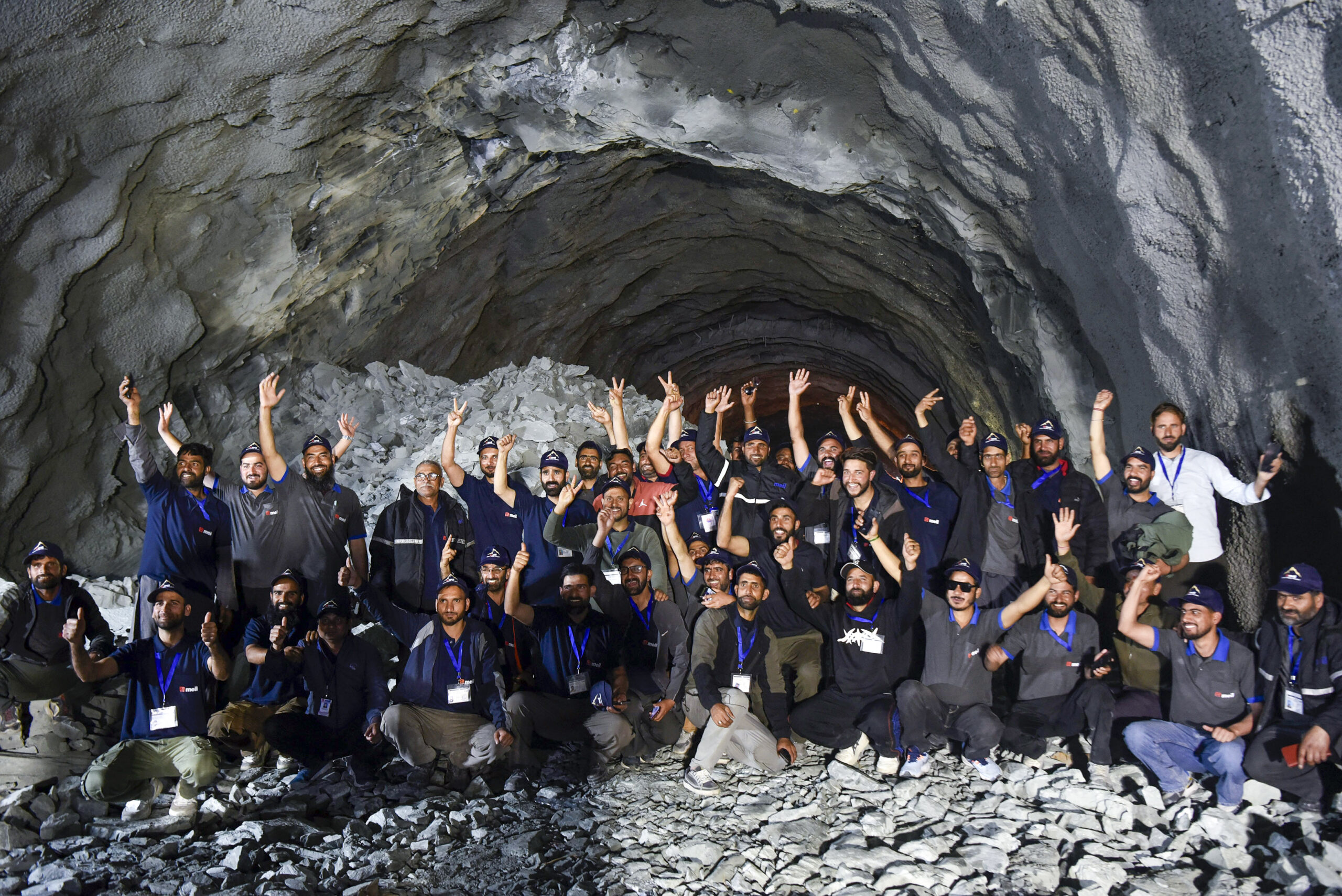
Leaders, residents hail ‘transformative milestone’
Umar Raina
Srinagar, Jun 09: The historic breakthrough of the Zojila Tunnel on Tuesday triggered celebrations across Union Territory of Ladakh, with political leaders, public representatives, religious organisations, and residents hailing the achievement as a transformative milestone that will redefine connectivity, accelerate economic growth, and unlock the region’s vast tourism potential.
The breakthrough marks a major milestone in the construction of Asia’s longest bi-directional road tunnel and brings the long-awaited all-weather connectivity project between Kashmir and Ladakh significantly closer to completion.
The landmark ceremony was attended by Union Minister for Road Transport and Highways Nitin Gadkari, Jammu and Kashmir Lieutenant Governor Manoj Sinha, Chief Minister Omar Abdullah, Members of Parliament, Ladakh councillors, senior officials, engineers, workers and representatives of the executing agencies.
For the people of Ladakh, particularly those living in Drass, Kargil, Zanskar and other remote regions, the breakthrough was celebrated as a moment of historic significance, ending decades of uncertainty associated with seasonal road closures at the treacherous Zojila Pass.
Political leaders from across Ladakh welcomed the development and described it as the fulfilment of a decades-old aspiration. They noted that for generations, the Zojila Pass remained vulnerable to heavy snowfall, avalanches, landslides and prolonged winter closures, often cutting off Ladakh from the rest of the country for months.
Senior BJP leader Haji Inayat Ali termed the breakthrough a moment of pride for the people of Ladakh. He said residents had been waiting for years to witness the day and expressed hope that the remaining work would be completed at the earliest. “The tunnel would provide safer and more reliable year-round connectivity while significantly reducing travel hardships faced by the region’s inhabitants,” Ali said.
Chairman of the Ladakh Autonomous Hill Development Council, Kargil, Dr Jaffar Akhoon, described the tunnel as a major gift for the people of Ladakh. “The project would strengthen connectivity, stimulate economic activity, improve healthcare access and educational opportunities, and address longstanding developmental challenges faced by remote mountain communities,” he said.
Former Chief Executive Councillor of LAHDC Leh, Tashi Gyalson, hailed the breakthrough as a defining moment in Ladakh’s history. Congratulating the people of the Union Territory, he said, “History is being made as the Zojila Tunnel has finally achieved breakthrough connectivity, marking a monumental milestone for Ladakh. Heartfelt congratulations to the people of Ladakh on this historic achievement.”
Gyalson expressed gratitude to Prime Minister Narendra Modi and Union Minister for Road Transport and Highways Nitin Gadkari for their visionary leadership and unwavering support in turning the long-pending dream of all-weather connectivity into reality. “The project is a landmark achievement that would transform the socio-economic landscape of Ladakh and strengthen its integration with the rest of the country,” he said.
Prominent social activist Sajjad Kargili said the people of Kargil have long pursued three major aspirations: restoration of air services to Kargil, development of the Karba Thang Township, and construction of the Zojila Tunnel. With the tunnel breakthrough, he said, one of the most significant and historic demands of the region is now firmly on the path to realisation.
Kargili credited the achievement to decades of collective efforts by political, social and religious organisations, public representatives, community leaders and civil society groups from Kargil and Drass who consistently advocated for the project and kept the demand alive.
Kargil’s premier religious and social organisation, Jamiat Ul Ulama Isna Asharia Kargil, also celebrated the breakthrough and termed it the fulfilment of a dream cherished by generations. Addressing a press conference, General Secretary Sheikh Ibrahim Khalili and In-charge Political Affairs Sajjad Kargili said the tunnel had remained one of the most important demands of the people of Kargil and Drass for decades.
They said the achievement was the result of sustained efforts by local communities, activists, religious bodies and political leaders who tirelessly pursued the project despite numerous challenges over the years.
Public representatives across Ladakh echoed similar sentiments, stating that the breakthrough represents a turning point in the region’s development trajectory. They said the tunnel would usher in a new era of uninterrupted connectivity between Srinagar, Drass, Kargil and Leh, reducing travel time and ensuring reliable movement of people and goods throughout the year.
Residents of Drass expressed particular joy over the development, recalling how road closures at Zojila often left communities isolated during the winter months. Locals said disruptions on both sides of the route frequently hampered the supply of essential commodities, medicines and emergency services while making access to advanced healthcare facilities difficult.
Many residents recounted instances when severe weather conditions disrupted transportation for weeks, creating hardships for thousands of families. They believe the tunnel will finally end decades of seasonal isolation and dramatically improve the quality of life in the region.
Apart from improving connectivity, stakeholders highlighted the enormous tourism opportunities that the tunnel is expected to create. They said year-round accessibility would revolutionise Ladakh’s tourism sector, which remains one of the primary drivers of the region’s economy.
At present, heavy snowfall and winter road closures restrict tourist movement for several months annually. However, once the tunnel becomes operational, tourists will be able to travel to Ladakh throughout the year, opening new opportunities for hotels, guest houses, homestays, transport operators, restaurants and other tourism-related businesses.
Local tourism stakeholders believe improved accessibility will attract a larger number of domestic and international visitors, boosting employment and generating fresh economic opportunities across the region.
Representatives from Drass emphasised that the area possesses tremendous untapped winter tourism potential. Known as one of the coldest inhabited places in the world, Drass offers spectacular winter landscapes, snow-covered mountains and unique cultural experiences. They said the tunnel would enable tourists to safely access the region even during harsh winter conditions, paving the way for the growth of winter tourism on an unprecedented scale.
Leaders also noted that the benefits would extend beyond Drass to Kargil, Zanskar, Leh and several remote areas of Ladakh. Enhanced accessibility is expected to strengthen adventure tourism, eco-tourism, cultural tourism and religious tourism, positioning Ladakh among the world’s leading mountain tourism destinations.
Stretching approximately 14 kilometres beneath the Zojila Pass, the tunnel is designed to provide all-weather connectivity between Kashmir and Ladakh by bypassing the existing high-altitude route. Once completed, it will ensure uninterrupted traffic movement regardless of snowfall, avalanches or adverse weather conditions.