

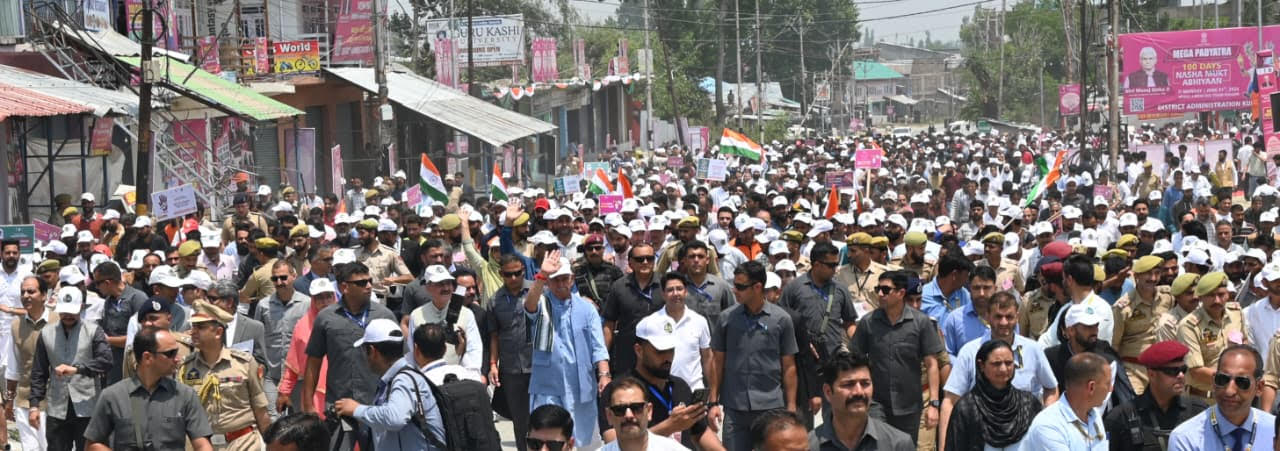
Kulgam: By the time Lieutenant Governor Manoj Sinha began his padyatra through the streets of Kulgam on Monday, the district headquarters had already been awake for hours.
Schoolchildren carrying anti-drug placards, college students, traders, government employees, women and elderly residents lined the route, many arriving early in the morning to join the administration’s 100-day Nasha Mukht J&K campaign.
The scenes carried a symbolism that would have been difficult to imagine a decade ago. The streets of Kulgam and much of south Kashmir that once frequently witnessed separatist protests, shutdown calls and politically charged mobilisations were on Saturday hosting a very different kind of public movement. Instead of political slogans, students carried banners against drug abuse.
Instead of competing political narratives, the focus was on a social crisis that increasingly worries families across Kashmir.
Over the past few weeks, Manoj Sinha has become the most visible face of the administration’s 100-day Nasha Mukht J&K campaign, leading padyatras across districts and repeatedly urging citizens, students, parents and community leaders to join what the administration describes as a people-led movement against drug abuse.
Launched earlier this year, the campaign combines public awareness drives, community outreach, rehabilitation initiatives and intensified action against drug peddlers.
Among those who had arrived early was 23-year-old college student Aaqib Ahmad.
“The drug problem was always there, but people rarely spoke about it openly,” he said. “Over the last few years, and especially during this campaign, the issue has come into the public domain. Today people understand that addiction is not just a family problem but a societal challenge.”
Standing nearby with a walking stick was 74-year-old Ghulam Mohammad Dar, who had travelled from a neighbouring locality to witness the event.
“There was a time when people came onto these roads for political causes,” he said, watching the procession move through the town. “Today they have come out to save their children from drugs. That itself tells you how the priorities of society have changed.”
Dar said he could not remember another social campaign drawing such public attention in recent years.
“I have seen many government campaigns over the decades, but this is one issue on which people genuinely want action,” he said. “The Lieutenant Governor has spoken about saving our youth from drugs again and again. The fact that so many people have come here today shows that people are listening.”
As the padyatra moved through the heart of Kulgam town, the crowd swelled along the route. Students chanted anti-drug slogans, volunteers distributed awareness material and residents watched from balconies and shopfronts. Many attempted to approach the Lieutenant Governor, sharing concerns and suggestions about the growing menace of substance abuse.
Among the participants was 38-year-old homemaker Rukhsana Akhtar, who had joined the walk along with a group of women from her neighbourhood.
“As mothers, we worry about the future of our children,” she said. “The administration’s focus on awareness and rehabilitation has given many families hope that this problem can be tackled before it destroys more young lives.”
“When a campaign reaches ordinary neighbourhoods and involves citizens directly, people feel they have a role to play,” she said. “Fighting drugs cannot be left to the police or the government alone.”
Her concern reflects a growing anxiety across Kashmir, where reports of substance abuse have increasingly emerged as a major social challenge. What was once seen as a problem affecting isolated individuals is now widely perceived as a threat to families and communities.
For years, discussions about Kashmir in the public sphere were dominated by politics, security and conflict. Saturday’s gathering suggested a shift in public attention toward social issues that directly affect everyday life.
The administration’s anti-drug campaign has sought to tap into that concern by framing the fight against narcotics as a collective responsibility rather than merely a law-enforcement exercise. Through awareness drives in educational institutions, outreach programmes and public events, officials have repeatedly stressed the need for community participation.
The padyatra in Kulgam appeared to embody that approach.
As Sinha walked through the town, stopping frequently to greet participants and interact with residents, the event resembled less a government programme and more a community mobilisation.
Children ran alongside the procession, elderly residents watched quietly from pavements and windows, and groups of young people used the occasion to voice their aspirations for a healthier future.
As the padyatra concluded and the crowd slowly dispersed through the streets of the district headquarters, conversations continued in small groups.
In a place once known for political mobilisation, thousands gathered around a different cause — protecting the next generation from the scourge of drugs. (Courtesy: Deccan Herald)