

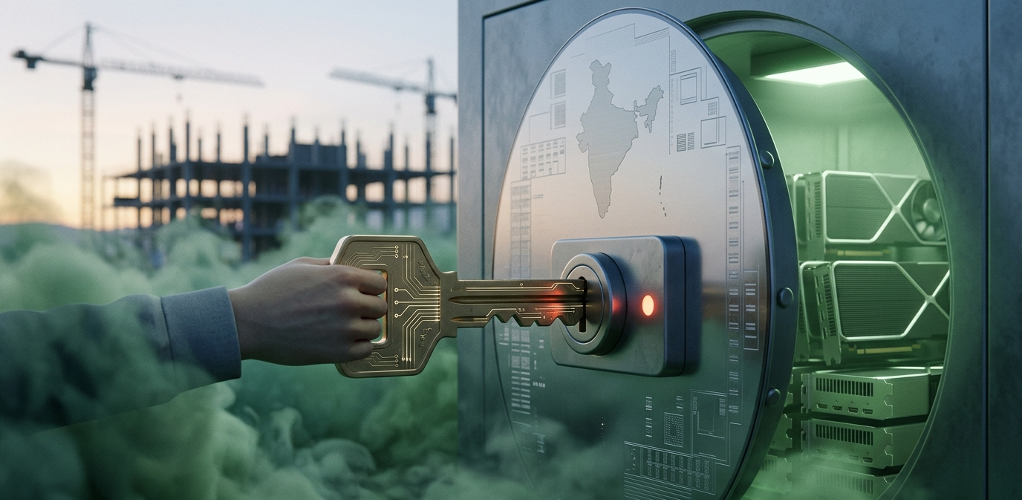
GPUs are not interchangeable in the way the public conversation suggests. NVIDIA’s edge is not the hardware
ARSSH KUMAR
FUTURECRAF|TECHNOLOGY & MARKETS
Sixty-seven rupees per GPU-hour. That is what an Indian AI startup pays today to train a model on an NVIDIA H100, the same chip that costs Silicon Valley between two and four dollars an hour on AWS. The Union government foots roughly forty percent of the bill. For foundation-model builders, it foots a hundred percent.
The IndiaAI Mission was approved in March 2024 with an outlay of Rs 10,372 crore. It has already deployed 38,000 GPUs and aims for 100,000 by the end of 2026. The Electronics and IT Minister, Ashwini Vaishnaw, has called it the cheapest national compute facility on earth. He is not wrong. He is also building the largest single obstacle to India’s stated goal of producing an indigenous GPU by 2029.
The numbers nobody is adding up
Sarvam AI received the largest single allocation under the Mission so far: 4,096 NVIDIA H100 SXM GPUs, supplied through Yotta Data Services, with a subsidy of Rs 98.68 crore against a project cost of Rs 246.71 crore. Three other approved foundation-model builders, Gnani.AI, GAN.ai and Soket, are expected to receive comparable allocations. Total subsidies disbursed under the GPU scheme have crossed Rs 111 crore.
That money is going to one place. NVIDIA, headquartered in Santa Clara, California.
In effect, the Indian taxpayer is now a sizeable indirect customer of a single American chip designer, and a price-setting one. The 100% subsidy for foundation-model training, confirmed in mid-2025, means the state pays the full hardware cost for any approved Indian builder. Vaishnaw has framed this as democratising access. It is also a guarantee of demand that NVIDIA could not have purchased at any price.
Meanwhile, the indigenous GPU programme that Vaishnaw himself announced sits in a different room.
First demonstrations were promised by end of 2025. Production was projected for 2029. As of mid-2026, the design phase is still being scoped, with two instruction-set architectures under evaluation. The fab partners are nowhere near operational. Tata Electronics signed with ASML on May 16 for a $11 billion 300mm wafer facility in Dholera. Even on an optimistic timeline, the first commercially viable Indian-designed GPU will reach the market three to four years after every serious Indian AI company has built its codebase on someone else’s silicon.
The CUDA lock-in nobody mentions
GPUs are not interchangeable in the way the public conversation suggests. NVIDIA’s edge is not the hardware. It is CUDA, the software layer that translates a developer’s code into instructions the chip understands. Around CUDA sits an ecosystem of libraries, cuDNN, TensorRT, the lot, that have been refined over fifteen years. AMD’s open-source alternative, ROCm, can technically run most CUDA workloads through a translation layer called HIP. Most analysts still treat the gap as a chasm rather than a step, particularly at the training scale.
Every model trained on subsidised H100S under the IndiaAI Mission is being built on the CUDA stack. Every Indian engineer being skilled up on these clusters is acquiring CUDA muscle memory, not portability. When Sarvam’s 105-billion-parameter model was released in March 2026 with open-source weights, the corpus and the architecture were Indian. The instruction set was not.
This is the asymmetry the sovereignty pitch papers over. India can build models in India, train them on hardware physically located in India, on data held in India under the Digital Personal Data Protection Act. The architecture under the subsidy is foreign, and so is the muscle memory it builds.
The architecture under the subsidy is foreign, and so is the muscle memory it builds. By 2029, a generation of Indian AI engineers will have spent their entire careers inside someone else’s instruction set.
The Vedanta-Foxconn ghost
India has been in this corner before. In 2022, the Vedanta-Foxconn joint venture was announced as a $19.5 billion semiconductor fab in Gujarat. By July 2023, Foxconn walked. The official reason was that the project was “not moving fast enough”. The deeper reason was that India lacked a credible downstream order book at the volumes a leading-edge fab requires to justify the capital.
A fab is not a factory in the conventional sense. It is a financial instrument that pays for itself only at high utilisation. To make Tata’s Dholera facility commercially viable, India needs guaranteed demand for Indian-designed chips at scale. That demand has to come from Indian AI companies. And those companies, by the design of the IndiaAI Mission’s own incentive structure, are being trained to want exactly one thing.
The next NVIDIA card.
Tribune’s analysis in January put the dependency plainly. India’s AI growth today rests on foreign-made accelerators from NVIDIA, AMD and Intel. SemiAnalysis has warned that export controls of the kind already imposed on China could be extended further as model capabilities scale. The Biden administration’s AI Diffusion framework, before being rolled back by Trump in 2025, had India in Tier 2 with a 50,000 H100-equivalent cap through 2027. The cap is gone for now. The leverage that produced it is not.
The honest counter
The steelman is real. India cannot wait for indigenous silicon while the US and China race ahead with frontier compute. Subsidised access to NVIDIA hardware is the only way Indian foundation-model builders compete on the same starting line, not behind it. Sarvam-105B exists because the compute existed. Take away the subsidy and the model does not get built. The bridge logic holds in the short run.
The rebuttal is that bridges become destinations when the off-ramp is never built. The 100% subsidy for foundation training has no sunset clause. The 40% subsidy for inference, where the long-term value of the Indian AI market actually lives, has no transition pathway to Indian silicon either. The Mission’s own documents lay out the seven pillars: subsidised compute, foundation models, datasets, applications, skilling, safety, and startup financing. There is no pillar for “demand commitment to indigenous hardware”. The strategy that would close the loop is the one missing.
Bottom Line
India is running two AI strategies that actively undermine each other. The first buys NVIDIA at scale today and gives it to Indian builders at a fraction of the global rate. The second promises an indigenous GPU by 2029. Each is defensible on its own. Together, they form a structural contradiction.
When the indigenous chip ships, the market it was meant to serve will already be locked into someone else’s stack. The engineers will have spent four years learning CUDA, not the Indian instruction set. The startups will be debugging in libraries written in Santa Clara. The fabs will look at the order book and wonder why they were built.
Sovereignty is not just where the data centre sits. It is who writes the instruction that the chip executes when the data centre lights up. By that measure, the cheapest computer on earth has turned out to be the most expensive thing India could have bought.
( The Author studies Computer Science and Artificial Intelligence at Rutgers University, New Jersey, USA. He is interested in emerging technologies and innovation, and can be reached on LinkedIn at @arssh-kumar14)