

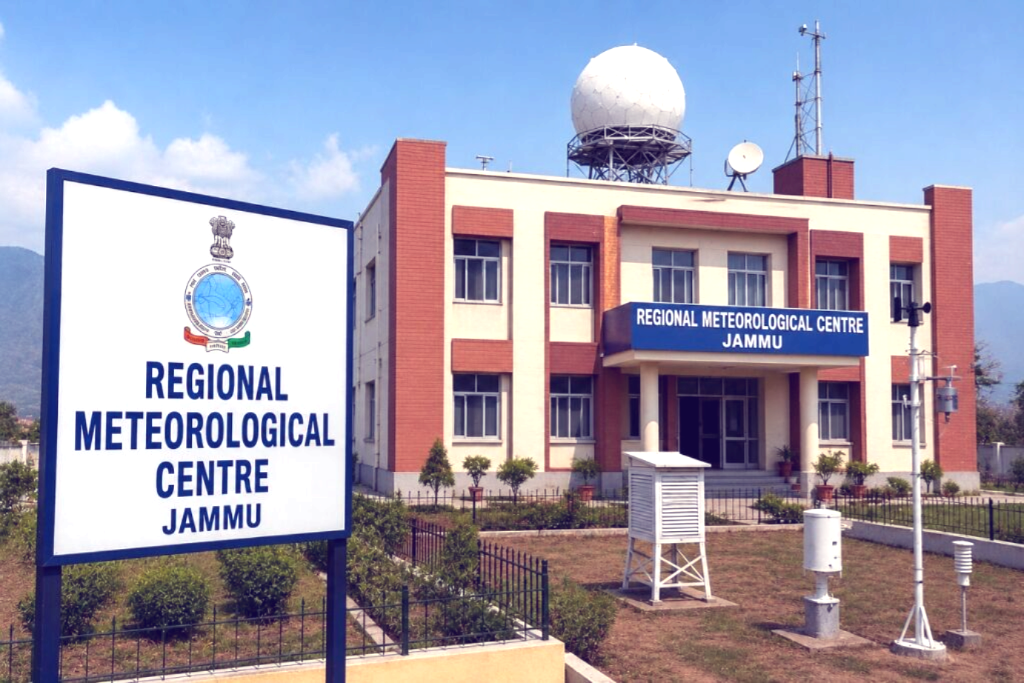
- New weather hub to serve J&K, Ladakh, HP
- Focus on mountain forecasting, disaster alerts
- 50 more radars to come under Mission Mausam
- Historic restructuring of IMD: Dr Jitendra Singh
Abid Bashir
Jammu, Jun 05: Marking a major overhaul in India’s weather forecasting architecture, the Union Government on Friday launched a Regional Meteorological Centre (RMC) in Jammu, a move aimed at strengthening weather monitoring and disaster preparedness across the sensitive Himalayan belt of Jammu and Kashmir, Ladakh and Himachal Pradesh.
Union Minister Dr Jitendra Singh described the development as a “historic restructuring” of the India Meteorological Department (IMD), saying the 151-year-old institution is entering a new era of decentralised forecasting and region-specific weather services.
The newly upgraded Jammu Regional Meteorological Centre will now function as a specialised weather hub for the northwestern Himalayan region, with a sharp focus on mountain meteorology, snow forecasting, high-altitude weather systems and early warning dissemination in vulnerable areas prone to avalanches, flash floods and cloudbursts.
Addressing the gathering during the launch, Dr Singh said the decision was taken to reduce the operational burden on the Delhi Meteorological Centre, which until now had handled the entire northern belt. “Under the new arrangement, Jammu will oversee meteorological services for J&K, Ladakh and Himachal Pradesh, while Delhi will cater to Punjab, Haryana and the national capital region,” he said. A third regional centre for Uttar Pradesh and Uttarakhand is set to become operational in Lucknow on June 8.
“The Meteorological Department has completed 151 years, and today a new chapter begins with the decentralisation of northern weather services,” Dr Singh said, adding that accurate forecasting and timely warnings are becoming increasingly crucial in the face of rising climate-linked disasters.
The Centre also unveiled an ambitious expansion of India’s radar network under “Mission Mausam”, with plans to install 50 additional weather radars across the country in the coming years. Dr Singh said India had only 17 weather radars in 2014, but nearly 30 more have been added over the past decade, taking the current total close to 50.
The expanded radar network is expected to significantly improve real-time tracking of rainfall, thunderstorms, snowfall and extreme weather activity, particularly in mountainous regions where terrain often complicates forecasting.
Highlighting recent technological advancements, the minister said the IMD’s “Nowcast Service” is now capable of delivering highly accurate weather forecasts up to three hours in advance, allowing authorities to respond more effectively to rapidly changing weather situations.
He also referred to the newly introduced “SkyCast” system at Delhi International Airport, which provides advanced fog forecasting and helps minimise weather-related flight disruptions.
Calling weather forecasting an essential pillar of Prime Minister Narendra Modi’s vision of a “Viksit Bharat”, Dr Singh said improved meteorological infrastructure would play a critical role in protecting lives, infrastructure and economic activity.
He further disclosed that the IMD has signed Memorandums of Understanding with institutions in Jammu and Srinagar, along with the Department of Science and Technology, to strengthen climate research, data-sharing and scientific collaboration under the government’s “Whole-of-Government” approach. Officials believe the Jammu RMC will emerge as a strategic weather command centre for the Himalayan region at a time when climate change is intensifying extreme weather events and increasing the need for precise, localised forecasting.