

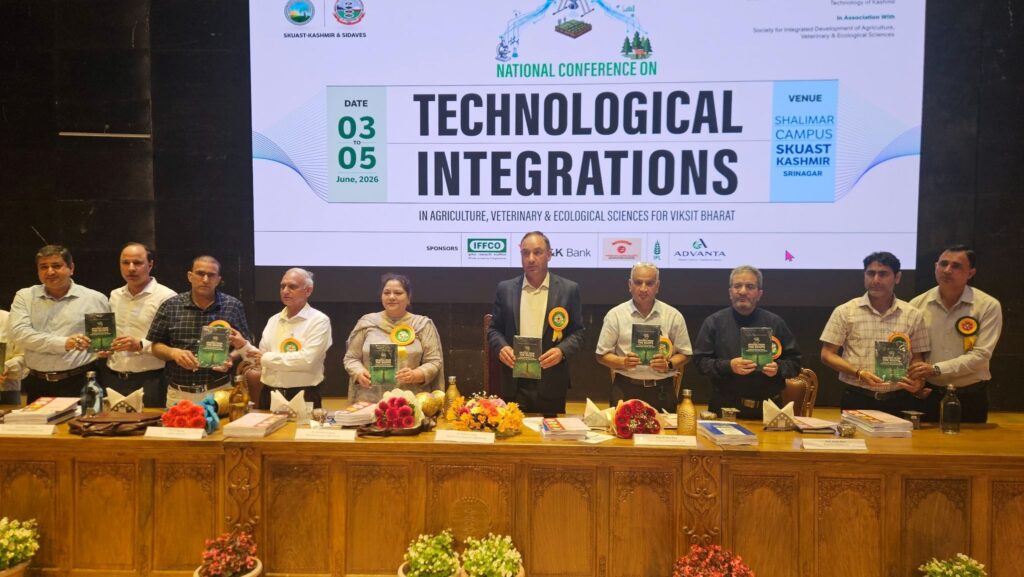
Srinagar, Jun 3: A three-day national conference on ‘Technological Integrations in Agriculture, Veterinary and Ecological Sciences for Viksit Bharat (TIC-2026)’ today commenced at Sher-e-Kashmir University of Agricultural Sciences and Technology of Kashmir, Shalimar campus.
The conference, organised in association with Society for Integrated Development of Agriculture, Veterinary and Ecological Sciences (SIDAVES), aims to serves as a national platform for deliberations on emerging challenges and opportunities in agriculture, horticulture, livestock, fisheries, veterinary sciences, and ecological sustainability.
Vice Chancellor, SKUAST-K, Prof. Nazir Ahmad Ganai, who was the chief guest at the inaugural session, emphasised that technological integration is crucial for transforming India’s agricultural landscape and achieving the vision of Viksit Bharat 2047.
Director Extension, Prof Raihana Habib Kanth outlined the objectives of the conference and its significance in promoting innovation-driven agricultural development through interdisciplinary collaboration and technological advancement.
The inaugural was also attended by Director Education, Prof Mohammad Altaf Bhat; Registrar, SKUAST-K, Prof Azmat Alam Khan; and Prof Jag Paul (JP) Sharma, Founder President of SIDAVES. Organising Secretary of the conference, Prof Fayaz Bahar, presented the vote of thanks.
Over the course of three days, experts will participate in eight technical sessions focusing on precision agriculture, nanotechnology, machine learning, genetic resource management, regenerative agriculture, post-harvest technologies, biodiversity conservation, and climate change management.
A special lecture on “Speed Breeding” is scheduled to be delivered by Prof. Vikas K Singh, Director and Lead South Asia at the International Rice Research Institute (IRRI).
More than 250 delegates from across the country are participating in the conference to present research findings, exchange ideas, and engage in meaningful discussions on contemporary challenges confronting the agricultural sector.