

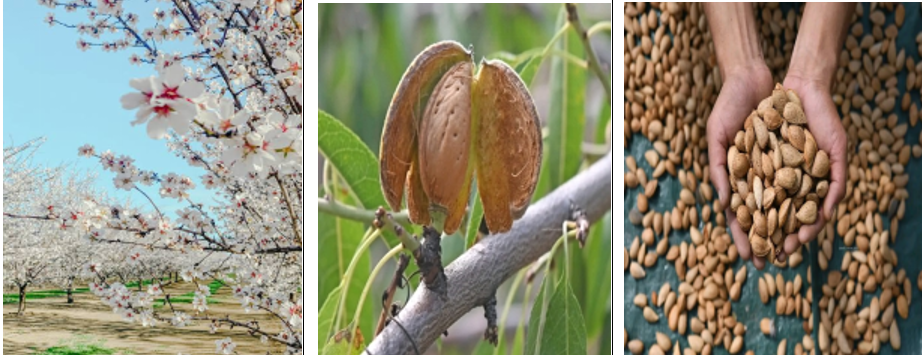
Jammu and Kashmir, particularly the Kashmir Valley, is the largest producer, accounting for over 90% of India’s almond production
PART-II
DR MEHRA-UD-DIN SHEIKH | DR MOHAMMED TAUSEEF ALI
Strategies for the revival of the Almond industry in the Kashmir Valley
The production of almonds is obtained from the acreage where plants are primarily of seedling origin. This situation leaves considerable scope for improvement in the production and productivity of this nut.
The following measures can help in the revival process:
Planting material
Free-of-cost planting material should be given to farmers, including replacement of planted dried plants up to 3 years, including all inputs like fertilisers, fungicides, pesticides, etc., for the proper establishment of almond orchards.
Rejuvenation of trees
Rejuvenating old but healthy almond trees in Kashmir will need to be carried out. The methodology to be adopted for almond rejuvenation involves pruning of first-order or primary branches in December-January, followed by top grafting with the Waris variety and Pranyij as polliniser.
Minimise the risk of frost damage
Planting of mid to late-flowering varieties which bloom 3rd week of March onwards to minimise the risk of frost damage and to take advantage of higher temperatures which are favourable for pollination and fertilisation, like Waris, Carmel, Ruby, Padre, Peerless, Nonpareil, Merced, Drake. New varieties which bloom likely in April, viz., Tardona, Antoneta, and Penta, can be a game changer in areas where the frost problem is severe and where other varieties cannot be cultivated.
Pollination management
Almonds are not self-fruitful; therefore, it is necessary to provide every third row in each farm with a polliniser variety (33 % pollinizer) so that their blooms coincide with each other. For commercial almond cultivation, pollinisers such as Ne Plus Ultra, Jordanalo, IXL, and Waris should be used. In addition to this, the placement of 4-6 beehives is found to be highly beneficial and can increase the fruit set and almond yield by 12-15%.
Irrigation management
To meet the requirement of irrigation, all methods of irrigation, viz., storage ponds, wells, ditches, river canals, drip irrigation, etc., should be developed and extended to supply water at all the critical stages and around the year whenever required. Merely extending the application of one particular method of irrigation may not be reliable to eliminate the water risk when the peak demand for water is everywhere in the region across horticultural crops.
Nutrient, Disease and Pest Management
Nutrients should be applied based on soil tests and leaf nutrient analysis. Diseases and pests should be managed as per the recommendations of SKUAST-Kashmir.
High-yielding varieties
To import new and high-yielding varieties like Carmel, Butte, Padre Primorskij, Peerless, Thompson, Price, Monterey, Ruby, Fritz, Sonora, Le Grand, Independence, Shasta, etc.
Breeding new cultivars
To breed new quality, market-oriented varieties with local climatic suitability and resistance to diseases and pests.
Layout of orchards
Due consideration should be given to the scientific layout of new orchards.
Porcupine management
The best current strategy to minimise the attack of porcupines is wrapping the lower tree trunk with hardware cloth, jute bags, metal sheets or plastic guards, which prevents porcupines from gnawing.
Tree shakers
Farmers in this area manually shake trees using long poles, a method that is time-consuming and poses safety risks. The advent of the tree shaker has drastically shortened the harvest period from several weeks to just a few days, reducing labour costs and nut loss while boosting overall production efficiency.
Hullers and shellers
Hullers and shellers should be used to remove outer hulls, shells, and any remaining orchard debris, such as thin twigs.
Processing, grading, and quality control should be established to include the purchase of the best and latest technology for producing high-quality kernels that meet grade specifications. Similarly, the enforcement of grading programmes, the operation of inspection systems, and control laboratories should also be established.
To ensure properly graded and quality nuts for the export markets, UT grade and quality certification must be kept for exports of nuts from UT. Various quality assessment laboratories must be established at various production centres in the UT, which should analyse the sample drawn from all shipments of nuts destined for export.
Upon such analysis, a certificate must be issued to the exporter indicating the grade of the nut product and a detailed analysis of the product. Each almond packet must contain a label indicating such analysis. Each exporter must be charged a nominal fee for such services to make it a self-supporting scheme. The nut producers and traders must be educated about the practical value of regulations to make the successful enforcement of such programmes possible.
Storage
Almonds are relatively low-moisture, high-oil-containing nuts with a long shelf life when properly handled and stored. The following recommended conditions will maximise the shelf life of almonds: Store under cool and dry conditions (<15 degrees Celsius and <60% RH). Almond moisture should be maintained within 3% to 6% for optimal stability. Use packages with good barrier properties against water and air transmission to prevent infestation and maximise shelf life. Avoid exposure to light and storing materials adjacent to them with extraneous odours.
Economic Packing System
An economic packing system for almonds should be developed and made easily available for marginal growers of the UT. The following particulars should be marked on the nut packet/box so that the consumer knows what he/she buys, how much he/she buys and so on.
a. Kind and variety of almond.
b. Grading mark.
c. Net weight when packed.
d. Date of packaging and expiry.
Taxes on Almond Nuts
To revive almond cultivation, GST should be exempted, and import duties on USA almonds should be increased from the existing Rs. 35/kg for in-shell and Rs. 100/kg for kernels, so as to make them more expensive.
Almond Research Centre
Should be established, which will serve as a crop improvement and germplasm centre, displaying on the spot different variety blocks, demonstrating modern scientific almond orchards, and showcasing the latest technologies from preharvest to postharvest, including grading, packaging, etc. Additionally, it will function as an education and training centre specifically for students, farmers, and growers, and it will raise general awareness among all concerned stakeholders. Exhibition-cum-demonstration centres/plots: should be set up in major almond nut-producing areas of UT.
Awareness on a mass scale
Such activities should be conducted by the horticulture department and relevant research institutions in almond-growing areas, where almond growers may be informed about the latest horticulture technology.
Publicity and advertisement campaign
A rigorous publicity and advertisement campaign should be launched to inform growers about almond production technology, fostering a scientific approach to cultivation among them.
Dry Fruit Mandi
The Kashmir Valley doesn’t have a central dry fruit market. Kashmir is one of the leading almond-growing areas in India, yet it still doesn’t have a dry fruit market. Farmers have to pack and move the almonds to marketplaces in Jammu or outside the UT on their own, which ultimately decreases their profit. Like apples, almonds need the right infrastructure to sell on time and avoid years of storage.
Financial Facilities
The financial lending institutions should allow the marginal farmers to simplify the documentation process for taking instant loans at least interest-free so that they are able to bear various pre-harvest expenses, which include the purchase of protectants, fertilisers, and modern implements for almond cultivation.
Crop Insurance
To save the almond production from various pre-harvest risks/damages, a crop insurance scheme may be fitted as per the life cycle of the almond crop. If all aspects are considered in its implementation, the crop insurance scheme would serve as a gateway to the future prosperity of the almond industry.
Improved Marketing Channels
Efforts should be made to overcome the influence of commission and forwarding agents on the almond trade and to establish such a distribution system of almonds that would ensure direct sale to the consumer. This type of marketing channel will be remunerative.
Establishment of Almond Marketing Information and Research Centres
The UT government should set up a large and fully fledged marketing research centre, which will be capable of conducting extensive market surveys for exploring new markets and developing existing markets both within and outside the UT, resulting in benefiting farmers. Such centres should undertake the following tasks:
- Investigate the demand for new market facilities and draw up plans and specifications.
- Conduct research in the marketing of important almond products with a view to developing more efficient methods and organisations.
- Examine potential grades and standards under the grading and standardisation law.
- Investigate the packing and transport of almond products, recommend improvements, and develop container standards.
- Compile and arrange for the publication of various marketing statistics, such as stocks of almonds and quality of almonds according to size, taste, etc., at regular intervals and issue the latest bulletin regarding demand and other market trends; and
- Compile reports on market prices and disseminate them to growers through radio, newspapers and social media.
Enhancement of Transport Facilities
Proper development of the almond industry is essential from all perspectives. The transport facilities of every mode have to be improved and expanded suitably. The construction of all-weather feeder roads in almond-producing areas should receive top priority to facilitate the movement of almond produce. Operating the special cargo railway service from the Kashmir Valley to the rest of the country will significantly reduce both transport time and costs.
(Dr Mehraj-Ud-Din Sheikh is presently working as Horticulture Development Officer, Directorate of Horticulture, Kashmir and can be reached at: shiekhmehraj10@gmail.comand Dr Mohammed Tauseef Ali is presently working as an Assistant Professor of Horticulture Technology, J&K Higher Education and can be reached at: tauseefwani500@gmail.com)