

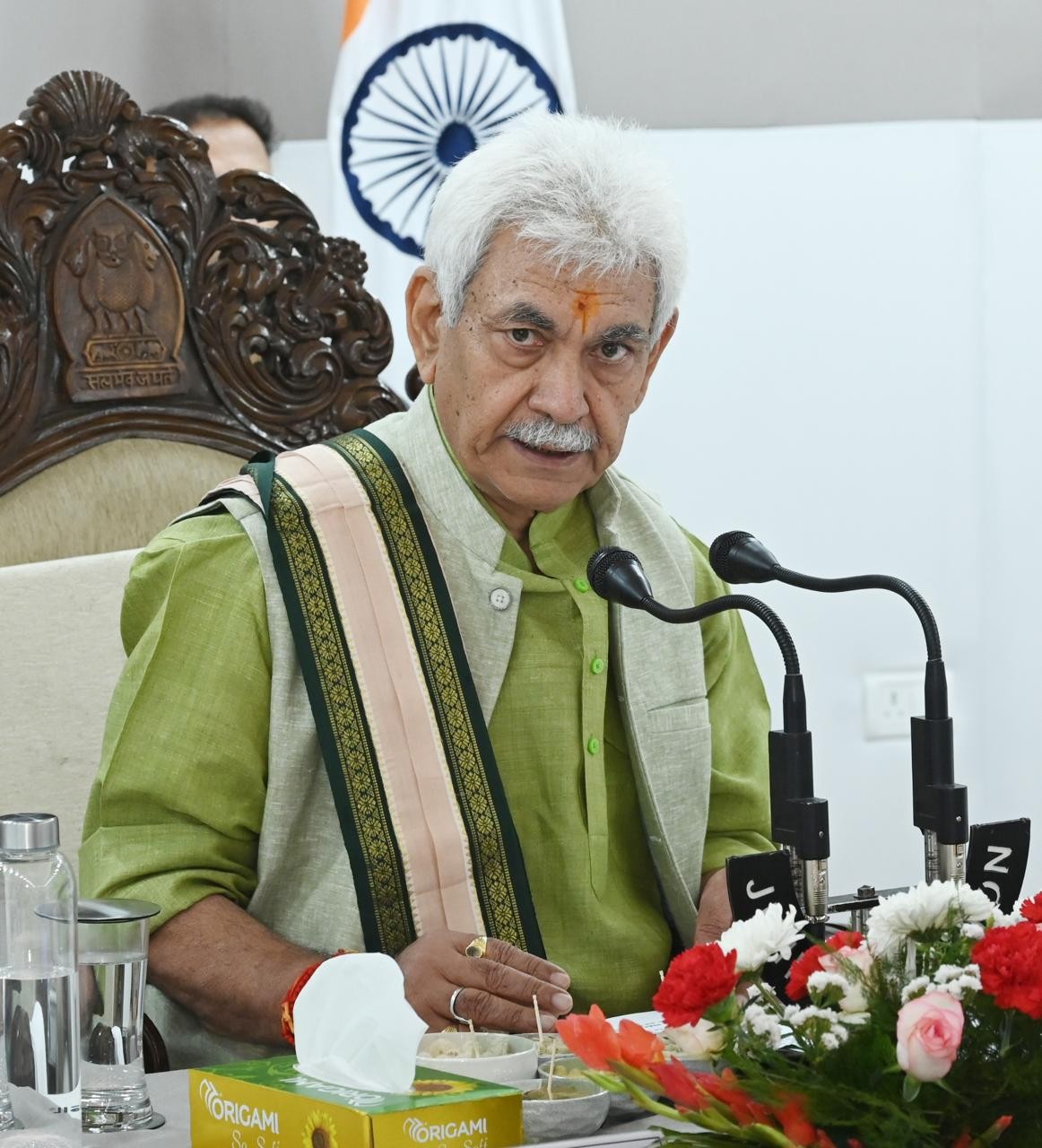
‘People now coming out openly against terrorism’
- Terror recruitment down to single digit
- 500 terror families given relief
- Operation Sindoor achieved its goal
- Agencies adapt to encrypted terror networks
- Drug conspiracy to destroy youth
- Narco-terror networks systematically crushed
- Unprecedented development across J&K
- Omar govt working ‘very good’
Shafat Malik
Srinagar, May 18: Asserting that Kashmir had begun “feeling the pain of terrorism directly” after the Pahalgam terror attack, Lieutenant Governor Manoj Sinha on Monday said public attitudes towards terrorism were changing, with more people openly distancing themselves from terror and violence.
In an interview with a national television channel, Sinha observed that change was becoming increasingly visible in public reactions to terror incidents, particularly after the Pahalgam attack, where demonstrations against violence were witnessed in several parts of Jammu and Kashmir. “I would say that this change is increasing in a significant way because people are now coming out openly,” he said.
Sinha said the administration viewed the shift not merely as a law-and-order development but as a broader social response shaped by years of violence and instability. “The pain is directly linked to terror and people are understanding it,” he added.
The Lieutenant Governor said the administration had intensified outreach towards families affected by terrorism over the past several decades, many of whom remained outside institutional support mechanisms despite existing provisions. “There was already a provision that such families could be given government jobs, but many had not received support,” he said.
Sinha said he personally interacted with several families affected by terrorism and described their experiences as “deeply emotional”, following which the administration accelerated rehabilitation and appointment processes. According to him, nearly 500 terror-affected families had either received appointment letters or approvals for government employment. “We have already issued approval letters to nearly 500 people,” he said.
The LG added that authorities were carrying out detailed scrutiny while processing such cases, noting that different categories of affected persons were approaching the administration for assistance. “Some people whose relatives were killed during anti-terror operations also approach authorities seeking similar benefits, so the process requires scrutiny,” he explained. The administration intended to continue rehabilitation measures and extend support to families affected by militancy. “We will help all terror victims and ensure rehabilitation in every possible way,” he affirmed.
Speaking on security, Sinha said Pakistan was continuing attempts to destabilise Jammu and Kashmir, but security agencies had strengthened counter-infiltration and anti-terror operations across both Kashmir and Jammu regions.
Referring to the Pahalgam attack and subsequent counter-terror operations, the Lieutenant Governor said security agencies had identified and tracked all those involved. “Our Army, Jammu and Kashmir Police and CRPF identified each one involved during Operation Mahadev,” he said. The response mounted after the attack reflected the government’s stated security policy, leading to Operation Sindoor carried out by Indian forces. “The target that was decided was achieved within the planned time. There was no need to go beyond that,” Sinha said, adding that the government’s clear operational objectives were met within “48 to 72 hours.”
Drawing a comparison with ongoing international conflicts, Sinha noted that prolonged wars elsewhere showed the importance of defined military objectives. “There are full-scale wars taking place in different parts of the world and outcomes are still uncertain. India achieved the target it had fixed,” he said.
On cross-border firing and drone-related incidents, Sinha said the administration and the Centre had extended support to affected civilians. “The Government of India has provided assistance to those affected, and rehabilitation measures are being monitored regularly,” he said.
The LG also said a “Vibrant Village” programme was being implemented to strengthen infrastructure and development in border areas. “The Prime Minister wants border villages to develop on par with any other village,” he said.
Asked why India had not expanded military operations further towards areas across the Line of Control that host infiltration camps, Sinha reiterated that the government’s stated targets had already been achieved. “The target was fixed before the operation, so there was no need to go beyond that,” he said.
Sinha addressed concerns regarding terrorism-related activity in the Jammu region, particularly in Kathua, Udhampur and Kishtwar, saying Pakistan had attempted to shift focus towards Jammu after facing pressure in Kashmir. “Our neighbour thought that since extensive operations were taking place in Kashmir, they should attempt activities in Jammu,” he said. However, the security grid in Jammu had now been strengthened substantially. “The Army, J&K Police and CAPFs are fully prepared there now,” he added. Operations in the region were progressing effectively, and security agencies were capable of responding to emerging threats.
On concerns regarding radicalisation through encrypted digital platforms, the Lieutenant Governor said security agencies were monitoring online activity and adapting to technological changes. “Everything is happening through phones and encrypted platforms now. As they change methods, we will also change methods,” he said. Multiple agencies were involved in monitoring such threats, and the situation remained under control. “Our security agencies are working on this very seriously, and there is full coordination among agencies,” he maintained.
Responding to a question regarding protests linked to developments in West Asia and concerns over possible radicalisation, Sinha said democratic expression would be permitted within constitutional limits. “As long as it remains within democratic limits, everyone has freedom of expression,” he said. At the same time, he warned that authorities would act if those limits were crossed. “The red line has been defined, and no one will be allowed to cross it,” he added.
Speaking on the 100-day Nasha Mukt Abhiyan, Sinha said the administration had launched a coordinated campaign against narcotics networks, terrorism and cross-border destabilisation, adding that the anti-drug drive was being carried out with “systematic action” and without targeting innocent persons.
The LG said the administration was simultaneously focusing on disrupting supply chains, public awareness, and long-term rehabilitation of drug addicts. “We are working on three fronts. The first is to completely disrupt the supply chain, second is awareness and third is rehabilitation,” he said.
Sinha said that during the last 37 to 38 days, police and security agencies had achieved “more than 90 per cent success” in disrupting narcotics supply chains. According to him, 766 FIRs were registered and 856 accused arrested during the period. He said 677 kilograms of drugs and 19,400 psychotropic substances had also been seized.
The Lieutenant Governor said authorities had identified “top gangsters and top smugglers”, while photographs of accused persons were being displayed at police stations. He said detention orders under PIT-NDPS laws had been issued against 31 persons, while properties worth Rs 52.41 crore had been attached. “The number of attached properties is 117. Property worth around Rs 17 to 18 crore has also been demolished,” he said. Asked whether bulldozers were being used, Sinha clarified that demolition drives were being conducted against identified properties linked to drug networks. “No bulldozers are in operation, but demolition is in progress,” he said.
Sinha also detailed administrative measures initiated during the campaign, saying action had been taken against 165 druggists and chemists, while driving licences, vehicle registrations and passports of accused persons were being targeted through legal processes. “Driving licence cancellation was recommended in 410 cases and cancelled in 188. Registration certificates were recommended for cancellation in 286 cases and cancelled in 103. Passports were recommended for impoundment in 22 cases,” he said. He added that lookout circulars had also been issued, while both forward and backward linkages of narcotics networks were being investigated.
Sinha said the administration was running awareness programmes across districts, educational institutions and religious platforms. “I am going to every district for this campaign. Teachers, religious leaders and sports activities are being involved,” he said. Volleyball tournaments under the theme of a “drug-free campaign” had already been organised, while football programmes were also being planned to engage youth through sports, culture and music. According to Sinha, nearly 4.52 lakh people had participated in sensitisation programmes.
Asked whether people were responding voluntarily, Sinha said participation had been “spontaneous”. He also said public reporting of addiction cases had increased after the administration intensified outreach. “There was a stigma earlier and people hesitated to report such cases. Now families are themselves informing authorities and police about addiction problems in their localities,” he said.
The Lieutenant Governor said the administration was finalising a rehabilitation policy aimed at monitoring recovering addicts for three years while also linking them with employment opportunities. “This is a major challenge and we accept it. Civil society is also being involved,” he said. He said treatment facilities were being expanded in medical colleges and district hospitals until dedicated rehabilitation centres become operational. “We already have some rehabilitation centres, but they are not enough. Instructions have been given to health authorities to make beds available in medical colleges and district hospitals,” he said.
Sinha said the administration would bear rehabilitation expenses. “There will be no shortage of funds. We will treat them and rehabilitate them,” he said, adding that the administration was also examining post-rehabilitation employment support. “If someone returns to the mainstream after rehabilitation, how can we connect that person with employment so that he does not return to the same circle again?” he asked.
Linking narcotics abuse with terrorism, Sinha said drug addiction was being used as a tool to weaken society and facilitate terror recruitment. “I believe this is a conspiracy to destroy the youth of India through drugs,” he said. Referring to past terrorism cases, he noted that several recruits had links with substance abuse.
The LG said terror recruitment in Jammu and Kashmir had sharply declined over the years. “Recruitment has become negligible. The numbers which were once in three digits have now come down to single digits,” he said. Sinha added that most top terrorist commanders operating in the Valley had already been eliminated, and infiltration attempts from across the border were also being countered. “Infiltration is taking place out of helplessness, and those infiltrating are also being neutralised quickly,” he said.
Asked about changes in J&K after 2019, Sinha said infrastructure expansion, tourism growth and investment had altered the economic landscape of Jammu and Kashmir, adding that people in the Union Territory increasingly viewed their future “with India”. He said the pace of development and economic activity had increased substantially. “I feel that people in J&K are now living peacefully and the pace of development has increased significantly,” he said.
Sectors linked to tourism and local economic activity had created what he described as “stakeholders of peace”. “The stakeholders of peace have increased with hotel owners, taxi drivers, shikara operators, handicrafts and handloom workers,” Sinha said. He added that the administration had focused on agriculture and allied sectors, which remained linked to nearly 65 to 70 per cent of the population.
Referring to Jammu and Kashmir Bank, Sinha said the institution had moved from losses to profits. “When I came here, the bank was running in losses of around Rs 13 to 14 billion. Now its profit has crossed Rs 2,000 crore,” he said.
The Lieutenant Governor also referred to major infrastructure projects undertaken after the abrogation of Article 370, including highways, expressways and railway connectivity. “Now a person can travel from Kashmir to Kanyakumari by train,” he said. Sinha said many residents in J&K acknowledged changes in infrastructure and development works after 2019. “People here say that they had not seen this scale of development earlier,” he said.
Asked whether Prime Minister Narendra Modi had gained greater public acceptance in Kashmir, Sinha said support for the Prime Minister had existed earlier and had increased further over time. “The acceptability of the Prime Minister was there earlier also and it has increased further,” he said. He added, however, that electoral choices and political preferences remained separate issues. “Voting and political choices are different matters,” he said.
Sinha rejected suggestions that development in J&K had remained confined to the Valley while Jammu was ignored. “Development should take place everywhere. There should be no injustice either with Kashmir or with Jammu,” he said, adding that after the Assembly elections, the administration was ensuring balanced development across regions.
Referring to the Centre’s decision to place the Indus Waters Treaty in abeyance, Sinha termed the move a “historic decision” reflecting “strong political will”. “This is a very significant decision of the Government of India,” he said, adding that the move would have long-term implications for hydropower generation and water infrastructure in J&K. “The economy of Jammu and Kashmir will also change because hydropower generation will increase,” he said.
Drawing comparisons with hill states, Sinha said J&K could emerge as a major hydropower-producing region similar to Himachal Pradesh. “Like Himachal Pradesh, Jammu and Kashmir can also become a major hydropower region,” he said. Several short-term, medium-term and long-term projects linked to water management and hydropower were currently under implementation. “Some projects are already under execution while some are at the tender stage,” he said, adding that repair and restoration work had begun on several old canal systems that had remained non-functional for years.
Speaking on the assembly elections, Sinha said the political process after the abrogation of Article 370 had followed the sequence earlier outlined by the Union government in Parliament. He said elections could not have been delayed indefinitely in a democratic system, adding that the Centre had already committed itself publicly to restoration of statehood “at an appropriate time”. “India is a democratic country and elections could not have remained suspended indefinitely,” he said.
Responding to suggestions that the UT administration should have continued for a longer period before elections were held, Sinha referred to statements made by Prime Minister Modi during the parliamentary debate on Article 370. “The Prime Minister had clearly said, first delimitation, then elections and statehood at an appropriate time,” he said. According to Sinha, the delimitation process required time, and elections were conducted after completion of that exercise.
Asked about demands by political parties for immediate restoration of statehood, Sinha said assurances made in Parliament should be trusted. “What was assured in Parliament has value,” he said.
Asked whether Omar Abdullah was functioning properly as Chief Minister, Sinha replied: “Very good.” He avoided elaborating further on political differences over the statehood issue. “I do not want to say more on this matter,” he said.
Sinha further said that public attitudes in J&K are changing, with people increasingly viewing peace, development and economic stability as interconnected. “The people here have it in their minds and hearts that their future is with India,” he added.