

The continuing institutional and psychological vacuum regarding Islamic calendar declarations within Jammu & Kashmir is deeply problematic and must be addressed with administrative necessity and a strategic requirement
DR SIDDHARTHA GHOSH
The last month in the Islamic calendar is called Zil Hijjah. Since the Islamic and Gregorian calendars do not align, the days of this month change annually. This month is of great importance to all the Muslims around the world, as this is the month within which the holy pilgrimage of Hajj occurs.
The Hajj pilgrimage is one of the five pillars of Islam and is desirable for Muslims who go on pilgrimage to the holy city of Mecca in Saudi Arabia. This month is also when Eid al-Adha is celebrated, which is also called Bakri Eid in India. In simple terms, the month of Zil Hijjah is the sacred Islamic month that pertains to Hajj, prayer, sacrifice, and the biggest celebration in the Muslim calendar.
Pakistan’s central moon-sighting committee claimed that the Zil Hajj moon was sighted on 17th May 2026, leading to what they perceive as the start of 1st of Zil Hajj 1447 A.H. on 18 May 2026. Accordingly, it was announced that Pakistan will observe Eid al-Adha on 27 May 2026.
Pakistani TV channels, religious broadcasters and associated clerical networks quickly disseminated the announcement. Within minutes, religious leaders and groups in Kashmir, publicly supporting Pakistan’s statement, declared the start of Zil Hijjah on 18 May.
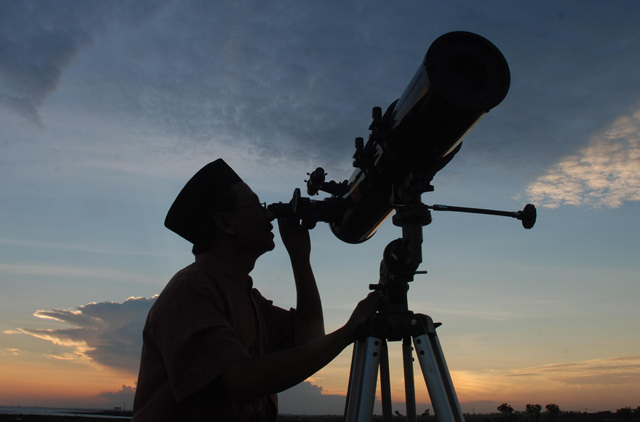
Meanwhile, The All J&K Shia Association (AJKSA), led by Imran Raza Ansari, carried out an independent moon sighting verification exercise in India, this time at the Indian Meteorological Department (IMD) observatory in Rambagh, Srinagar. They were present at the observatory with all the scholars and local observers and determined that no moon sighting from Kashmir or any other verified Indian observation point was recorded.
During the same time, consultations were done with Kargil and other areas in India, and no authenticated sighting was reported from there as well. Based on those observations, AJKSA announced that in Kashmir, 1st Zil Hijjah would begin on 19th May 2026, hence indirectly differentiating from the Pakistan-backed announcements.
Those groups in Kashmir who openly back the Pakistani announcement related to Islamic practices are often heard peddling a lie that Kashmir shares the same horizon as that of Lahore. But their argument lacks scientific and astronomical reality.
It’s noteworthy that while Srinagar is situated at approx. 34.07°N, Kargil at approx. 34.55°N and Lahore at approx. 31.52°N; it’s clear that geographically, Kargil is closer to Srinagar than to Lahore because of its latitude. Kargil and Kashmir share similar celestial and observational alignments. On the contrary, Lahore is located further south with different visibility conditions of the moon.
Kargil is hence a better option than Lahore when considering lunar visibility in Kashmir. Kargil is a high-altitude area that has less atmospheric pollution, less dust, and a generally clearer sky. Kargil is also a better lunar visibility reference point than Lahore, as the latter has high atmospheric distortion, greater dust density in its atmosphere, and varying times of sunset and moonset since it’s a plain area.
Hence, for practical as well as scientific reasons, Kargil is the better lunar visibility reference point for Kashmir. The religious experts in Kashmir must consider Kargil as their reference point of observation for all celestial observations, rather than relying upon a neighbouring country’s propaganda machinery.
Religion and religious observance are emotionally sensitive topics within Jammu & Kashmir. And any dispute regarding major festivals like Eid, Ramazan, Muharram or Islamic calendar declarations have the potential to trigger widespread disagreements, which can then be exploited by nefarious elements and can also be used for cross-border narrative peddling in Jammu & Kashmir.
This issue, rather than being a theological issue, has evolved into a psychological influence mechanism with a symbolic assertion of religious authority of Pakistan into the region. It also has Pakistan’s soft-power extension into Kashmir’s social sphere.
The situation, once again, shows the absence of a clear, well-structured, and technically supported Ruet-e-Hilal mechanism in Jammu and Kashmir, irrespective of the post-Article 370 administrative changes. Additionally, the situation exposed the continuing religious and psychological dependency of certain groups within Kashmir on the announcements of the Government of Pakistan regarding the Islamic practices.
The absence of an institutional moon sighting framework with scientific infrastructure in Jammu and Kashmir is sad since such an establishment will encompass universal legitimacy across various sects and regions.
The current situation points to a strong possibility that Eid-ul-Adha will again be observed on separate dates across Jammu & Kashmir, which not just adds up to administrative inconvenience but also increases sectarian discourse.
The immediate acceptance of Pakistani announcements by certain groups in Jammu & Kashmir, that too without any local authenticated verification, demonstrates a Pakistani-controlled influence on the religious ecosystem in the region. The Pakistani Media outlets have been using moon sighting announcements as a sort of symbolic demonstration of influence over Kashmiri religious sentiment.
The immediate measures which the administration can take is to establish an Official J&K Ruet-e-Hilal Committee, which must function under the Central Waqf framework and in coordination with the Indian Meteorological Department. The Committee’s headquarters must operate directly from the IMD observatory at Rambagh, as both technical and scientific capabilities are present in the facility. Also, this will serve as a direct central administrative linkage and lead to reduced local political interference.
Standard operating Procedures (SOPs) for moon sighting verification, witness authentication, technical observation and unified public communication must be developed for the future. In this process, scientific integration, telescopic imaging, lunar tracking, digital horizon mapping and atmospheric visibility analysis must be integrated. There must be a national religious synchrony where official Eid celebrations and holidays must remain aligned with authenticated Indian observation mechanisms rather than any foreign declarations.
A counter strategy must also be formed simultaneously, as there has been an observed pattern of Pakistani declarations being amplified in the Indian digital space. These coordinated acts of peddling cross-border religious messaging must be dealt decisively, and a tracking of the digital dissemination system must be done regularly in the region.
The government must ensure that the official Ruet-e-Hilal committee has credibility rooted in transparency, scientific grounding, inclusion of all sects and publicly accessible observation procedures. This continuing institutional and psychological vacuum regarding Islamic calendar declarations within Jammu & Kashmir is deeply problematic and must be addressed with administrative necessity and a strategic requirement.
( The Author is the Director of Red Lantern Analytica)