Jannat’s Mission Dal Lake: How a Father–Daughter Duo is Saving Kashmir’s Water Commons
-
 Insha Shirazi
- Comments 0
- 10 May 2026
The father–daughter duo’s initiative to save Dal Lake is fostering awareness and a sense of responsibility among local communities to conserve the lake’s pristine beauty
When Dal Lake comes to mind, it often evokes images of calm, fresh waters, ornate houseboats, and shikaras gliding, like scenes from a film. But beyond this postcard image lies a deeper, more complex reality.
A Tourist enjoys a Shikara ride in Dal Lake (Pic: Insha Shirazi)
Dal Lake, once known for its beauty and crystal-clear waters, is affected by several factors, including climate change, declining water quality, shrinking open waters, and encroachment.
Water Quality Shift in Dal Lake
“There is significant degradation of the Dal Lake water quality; The growth of aquatic vegetation, in summers, is almost two-thirds of the lake, and these are indicators of the health of the water body, which I don’t think are very healthy,” Professor Shakil Romshoo, Scientist, VC IUST, said while explaining the current situation of Dal Lake.
“If we look at the Dal Lake, taking 1970 as the baseline, there has been a significant decrease or declination in water quality, and one of the parameters that makes it unfit for drinking is the coliform count; basically a result of untreated wastes from houses and settlements going into the lake, where human waste and fecal matter have pushed coliform levels very high in Dal waters, making it unfit for drinking.”
Houseboat connected to STP’s
Sewage Treatment Plants (STP’s)
In February 2026, the Jammu and Kashmir government shelved its ₹416.72-crore Dal Lake restoration plan, after years of slow progress and limited success in relocating lake dwellers. The move marks a shift toward a more local, in-situ conservation approach for the iconic Srinagar water body.
“In the region, we have almost 58 habitations with a population of almost 20,000 people who live within the lake and on the peripheries of the lake. To address this, we have established 6 STPs at present; at Lam, Habak, Hazratbal, Nalla Amir Khan, Brari Nambal and another by UEED and by next year, we will have 7 STPs so that no raw sewage is allowed to enter the lake”, Former LCMA Vice Chairman, Manzoor Ahmad Qadri said.
“Out of almost 750 houseboats in Dal and Nigeen, all except 41 are connected to STPs for Rs 10 crores, and all hotels along the foreshore road and boulevard are also connected. All STPs conform to CPCB norms and are being upgraded to meet NGT norms. LCMA conducts water quality monitoring, and all the STPs are equipped with an online effluent monitoring system. Dedicated sensors installed at these STPs continuously assess both the inflow and effluent water quality.”
All eyes on 212 Cr Project
“People who live within the Dal Lake interiors are part of the ecosystem. Earlier, rehabilitation in Rakh-e-Arth housing colony was attempted but shelved due to complications,” Qadri said. “Now we have conceived an in-situ conservation plan, as dal dwellers cannot survive outside since their livelihood is linked with the lake. The idea is to let them remain while ensuring minimum impact. This ₹212 crore project, funded by the Ministry of Home Affairs, is in the pipeline and expected to be approved this year.”
Dal Lake Suffers
Despite these early successes, a major challenge remains: conservation and restoration plans for Dal Lake are not being fully implemented. The lake continues to shrink, and its water quality is deteriorating day by day.
The Comptroller and Auditor General of India, in its Report 4 of 2025 on the Conservation and Management of Lakes in Jammu and Kashmir, tabled on March 30, 2026, flagged serious lapses in the conservation of Dal Lake. The CAG has flagged serious lapses in the conservation of Dal Lake, saying the waterbody shrank from 15.405 sq. km in 2007 to 12.91 sq. km in 2020, a decline of 10.15 per cent.
The audit blamed gradual encroachments in areas such as Mir Behri, Lati Mohalla and Nandapora, rising built-up activity in catchment areas, and the discharge of untreated sewage from habitations lacking sewer networks and treatment plants. It also said six STPs sanctioned for Rs 21.46 crore and later installed for Rs 45.01 crore failed to treat sewage to the required standards, while major sewage-network works remained incomplete, allowing polluted water to keep entering the lake.
Professor Manzoor Ahmed Shah from the Dept of Botany at Kashmir University said, “Climate change is now allowing species to enter the system which earlier should not have occurred here, such as tropical species like Azolla, and these are emerging in Dal Lake due to changing conditions; it is also affecting the hydrological regime and water inflow. In this process, invasive species act as winners at the cost of native species, which are the losers, posing a major ecological challenge.”
Jannat’s Mission Dal Lake
Alarmed by the rapid degradation of water quality, climate change, and the decline in indigenous fish species such as Schizothorax (Kashir gaad), which once dominated the lake but have now dwindled due to the loss of their natural habitat and food sources caused by changes in the lake’s sandy and rocky bottom, a local Hanji (houseboat owner), Tariq Ahmed Patloo, started an initiative to save Dal Lake.
Through a Facebook page titled ‘Mission Dal Lake,’ he began raising awareness among locals about the ecological significance of Dal Lake, one of Kashmir’s vital water commons, particularly among communities living within and around the lake. The mission focused on spreading awareness, restoration plans, educating the common people about the lake water, climate change and the use of dustbins.
“I was born on the waters of Dal Lake, and one day I went deep into its interior with a customer from Germany as his guide. While we were there, he smoked a cigarette, but instead of throwing the cigarette butt into the lake, he quietly kept it in his pocket. At that moment, I felt emotional. A foreigner, who had come from so far away, understood the value of Dal Lake and refused to pollute it. Seeing that made me think if he could respect and protect these waters, why couldn’t we, the people who were born and raised here? That moment stayed with me forever and became the beginning of my mission to save Dal Lake.
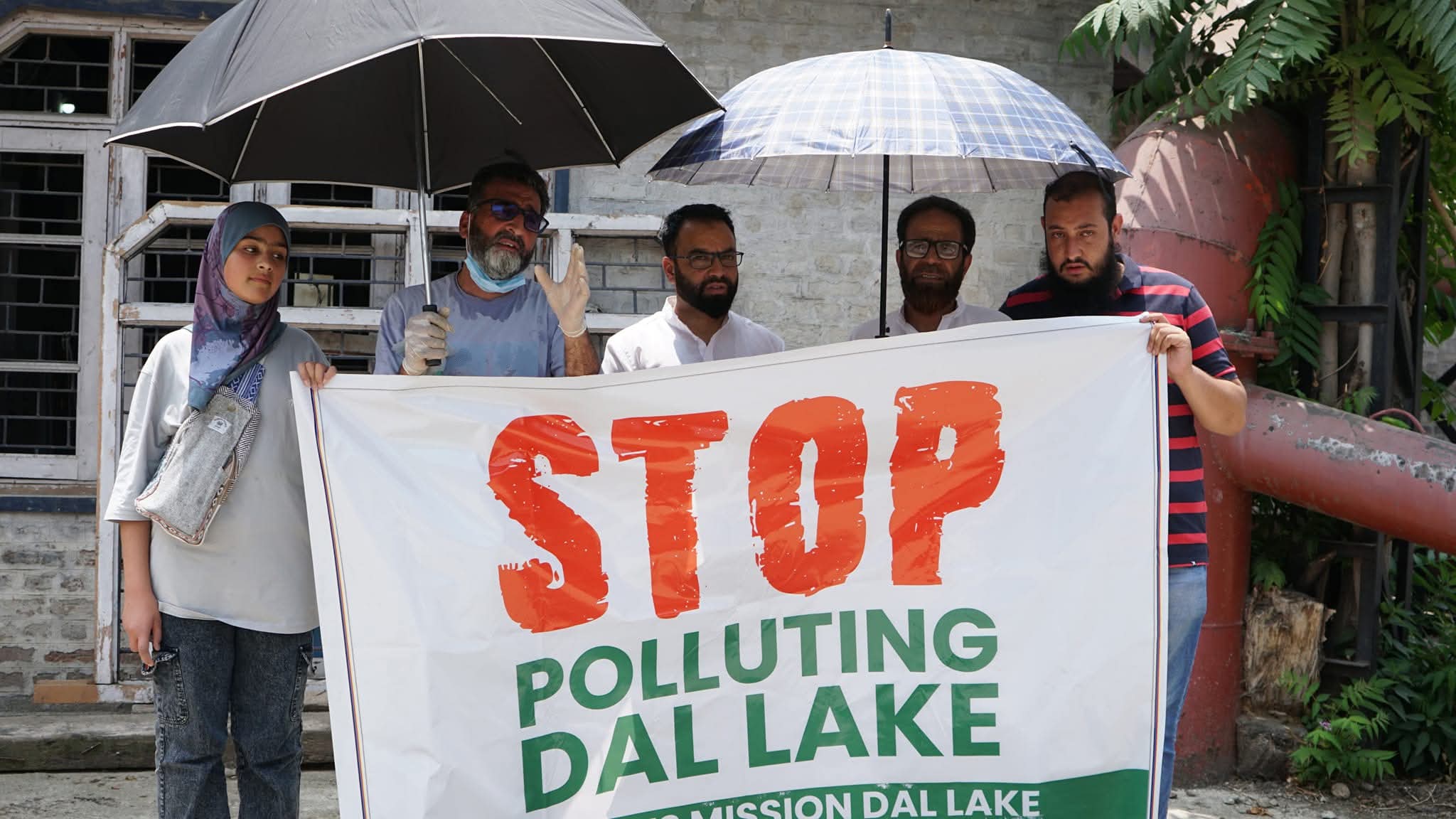
I started this mission (Mission Dal Lake) nearly a decade ago to protect Dal Lake, raising my voice against issues like garbage and encroachment, and identifying the areas that needed urgent attention. When my daughter Jannat was born, I renamed it from ‘Mission Dal Lake’ to ‘Jannat’s Mission Dal Lake.’ From the age of five, Jannat joined me in this journey with dedication. When PM Narendra Modi tweeted about Jannat and her efforts, it gave our mission wider recognition, and what began as my mission truly became hers,” says Tariq Ahmad Patloo, founder of Jannat’s Mission Dal Lake.
Tariq, gazing at the still waters of Dal Lake, said with a heavy heart: ‘We are just ordinary people, our hands can only do so much, and we try to do whatever little we can for the lake. But this pain needs more than small efforts; it needs a strong vision and honest governance. Every time they announce big plans and policies, we hope something will change… but on the ground, nothing really does. The promises fade, and the lake continues to suffer quietly.
In the years since, this mission has brought together college students, teachers & residents for cleaning drives, helping raise awareness among the wider community. The initiative has also had a positive impact on communities living within Dal Lake, especially those with limited awareness about waste disposal and sewage management practices.
From Facebook Page to Conservation Efforts
This initiative, Jannat’s Mission Dal Lake, saw the father–daughter duo begin cleaning Dal Lake on their own, without any external support. They conducted drives on designated days, using their own shikara and nets to collect plastic and other waste from the lake.
They also provided dustbins to the people living within Dal Lake and educated Shikara users to serve kehwa in disposable cups, while ensuring that waste is not thrown into the lake.”
Tariq Ahmed Patloo Distributes Dustbins
Jannat, 14, a Class 8 student, Member of Jannat’s Mission Dal Lake said, “Through our mission, we bring students from different schools and colleges. Recently, students from S.P. College, Srinagar, joined us for clean-up drives held on every Friday and Sunday of the week. This has been possible with the support of my father and Environmental Lawyer, Nadeem Qadri.”
“Recently, the MakeMyTrip Foundation joined us at Dal Lake, and we carried out extensive work during the winter. Through our Facebook page, ‘Jannat’s Mission Dal Lake,’ we reached out to communities across different mohallas within the lake, cleaning their surroundings and spreading awareness about not polluting their environment’’ she added.
Jannat further said. “We also ensured that every household and Shikara owner received dustbins with the support of the MakeMyTrip Foundation to encourage proper waste disposal and help keep Dal Lake, a shared water commons, clean.”
Dal Lake’s Water Ambulance
“My father built the first water ambulance in Dal Lake, which has greatly benefited the people living there. During COVID, when my father fell ill, no one was willing to cross the lake, and that situation made him realise how dangerous such delays could be if he was stranded one day, someone else could lose their life the next,” said Jannat.
“That experience led him to create the water ambulance. In Mann Ki Baat, PM Narendra Modi also mentioned my father’s name, appreciating for making the first water ambulance.”
It is equipped with a water pump to remove water if a houseboat begins to sink, and it can also help control fires using the same system. In addition, it serves as an emergency transport for medical needs,” Jannat said. “While there is no doctor onboard, we coordinate with roadside ambulances that meet us to assist patients, whether locals or tourists. Today, this water ambulance has become a lifeline for the communities living on Dal Lake.”
Nurturing the Next Generation
Even the youngest members of our community and family have begun to take an active interest in protecting Dal Lake.
‘Today, many school-going children who join our drives understand the importance of keeping the lake clean. They know about waste management and the impact of pollution on our environment,’ says Tariq Ahmed Patloo, whose initiative is now being carried forward by the younger generation, including his daughter Jannat.
Their consistent efforts, from participating in clean-up drives to spreading awareness in their communities, stand as a testament to how the younger generation is stepping up to preserve and restore Dal Lake for the future.
“Gulzar (name changed), a local shikara wala on Dal Lake, said: ‘I have a shikara where tourists come to enjoy rides. Earlier, I used to serve them kehwa in disposable cups, and sometimes we would throw them into the lake without thinking about pollution. But when I saw Jannat and his father cleaning the lake and spreading awareness about the harmful effects of plastic, it opened my eyes. Since then, I have stopped throwing plastic, and now I also request tourists not to pollute the lake, because this is not just water, it is our livelihood and our responsibility.’”
(The author is a recipient of the Promise of Commons Fellowship 2026, on the significance of Commons and its community stewardship)
Related Posts
-

Semax Peptide: Studies in Neuroprotection, Inflammation, and Vascular Impacts
-

Google now allow Gmail users to change their usernames
-

World Heart Day: 50% of heart attack cases occur without any prior warning, warns Expert
-

India tests drone-led surgery system ‘Vimana’ to cut delays in remote areas
-

NITI Aayog unveils roadmap to make J&K global horticulture hub
-

‘Paving Way for Digital Transformation’:Kangan school launches AI-Powered website
-

BPC-157: A Multifaceted Peptide with Expanding Horizons
-
Jannat’s Mission Dal Lake: How a Father–Daughter Duo is Saving Kashmir’s Water Commons

Leave a comment