

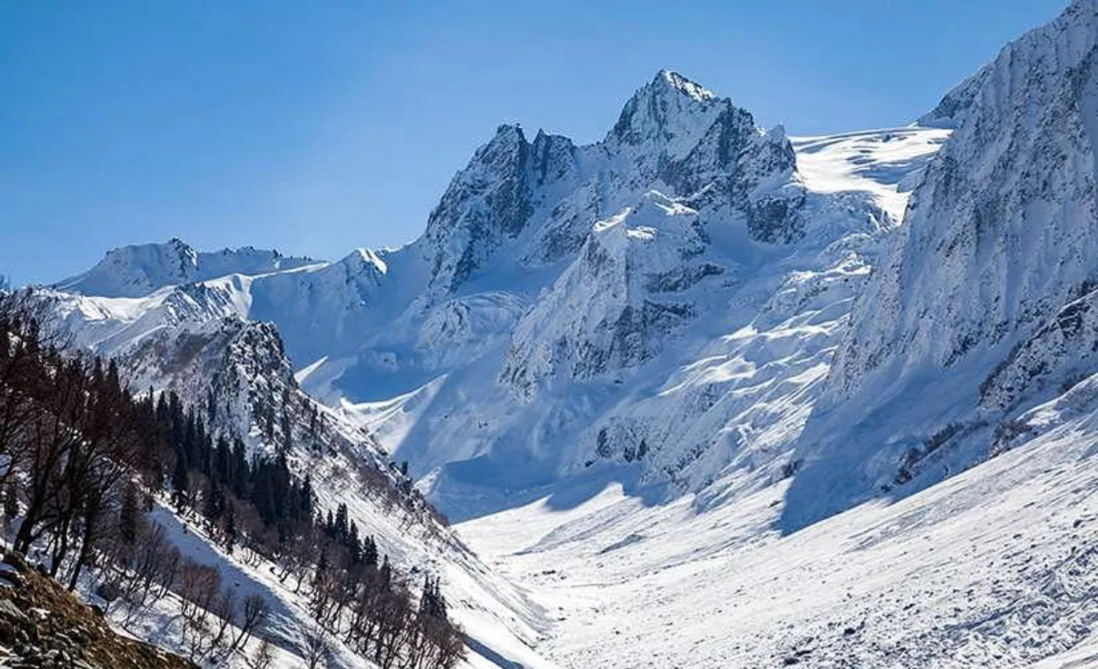
KU study finds altitude & even shadow cast by towering peaks influence glacier retreat
Abid Bashir
Srinagar, May 31: A new study on melting glaciers has revealed that rising temperatures alone do not determine a glacier’s fate. In the high mountains of Kashmir, shadows cast by towering peaks, the thickness of debris covering the ice and even the steepness of a glacier’s slope can mean the difference between rapid retreat and relative survival.
The research done by the Kashmir University (KU), which tracked changes in nine glaciers between 1992 and 2020, presents a fascinating picture of how local geography can influence the response of glaciers to a warming climate.
Scientists found that while all glaciers studied have been retreating, the rate of retreat varies considerably depending on their physical characteristics.
One of the clearest patterns observed was the role of altitude. Glaciers located at higher elevations generally showed lower rates of retreat compared to those situated at lower altitudes.
The glacier identified as G8 recorded the lowest recession of around seven per cent during the study period. Researchers attribute its resilience largely to its average elevation of nearly 4,700 metres above sea level, making it the highest glacier among those examined.
“At such elevations, temperatures remain considerably lower, allowing snow and ice to persist for longer periods and reducing overall melting. In contrast, Glacier G6 suffered the highest area loss of nearly 33.5 per cent. Scientists believe its relatively lower elevation exposed it to warmer temperatures, accelerating ice loss over the years,” the study states. “The findings reinforce a growing body of evidence suggesting that altitude remains one of the strongest natural safeguards against glacier retreat.”
Yet the study also uncovered a remarkable exception. Despite having one of the lowest average elevations among the glaciers investigated, Glacier G2 displayed a surprisingly modest retreat rate. The explanation, researchers say, lies not in altitude but in shadow.
Located beneath steep surrounding mountains, much of the glacier’s ablation zone remains shaded for long periods during the day. This natural protection reduces the amount of solar radiation reaching the glacier surface and slows melting.
In essence, the surrounding mountains act like giant umbrellas, shielding the glacier from direct sunlight. The discovery highlights how topography can sometimes offset the effects of warming temperatures and demonstrates why neighbouring glaciers can behave very differently despite experiencing the same climatic conditions.
Another important finding concerns the role of debris cover. Three of the nine glaciers studied were covered by varying amounts of rock fragments and sediment, while six were relatively clean ice glaciers. Contrary to the assumption that debris always protects glaciers, researchers found that debris-covered glaciers actually lost more area overall than clean-ice glaciers.
The debris-covered glaciers recorded an average loss of about 23.4 per cent, compared to 18.3 per cent for clean glaciers. Scientists explain that the impact of debris depends largely on its thickness. Thin layers of debris absorb solar heat and transfer it to the underlying ice, increasing melting rates. Thick debris layers, however, act as insulation and can help preserve glacier ice.
This effect was particularly visible in the Hoksar Glacier, where a substantial debris layer appears to have reduced retreat despite otherwise unfavourable conditions.
Similarly, the Machoi Glacier displayed a slower retreat rate than expected. Researchers attribute this to its relatively high elevation and steep slope, which helps maintain a healthy transfer of ice from accumulation zones to lower reaches of the glacier.
The study also documented substantial changes in glacier snout positions over the 28-year period. Several glaciers retreated hundreds of metres, while some lost more than three-quarters of a kilometre from their termini.
Such changes, scientists warn, have implications far beyond the mountains.
Glaciers serve as natural reservoirs, releasing meltwater that sustains rivers during dry periods. Their gradual disappearance could affect water availability for agriculture, drinking supplies, hydropower generation and ecosystems across Kashmir.
Researchers say the findings underline the need to understand glaciers not merely as victims of climate change but as dynamic systems influenced by a range of environmental factors.
The study’s most important message may be that the future of Kashmir’s glaciers will not be determined by temperature alone. Height, slope, debris cover and even the angle at which sunlight strikes a mountain valley can influence whether a glacier retreats rapidly or holds on for a few more decades. In the Himalayas, where every glacier is a vital water bank, those differences could prove crucial for the region’s future water security. As the climate continues to warm, the race to understand these hidden factors may become just as important as measuring the ice that is disappearing from Kashmir’s mountains.