

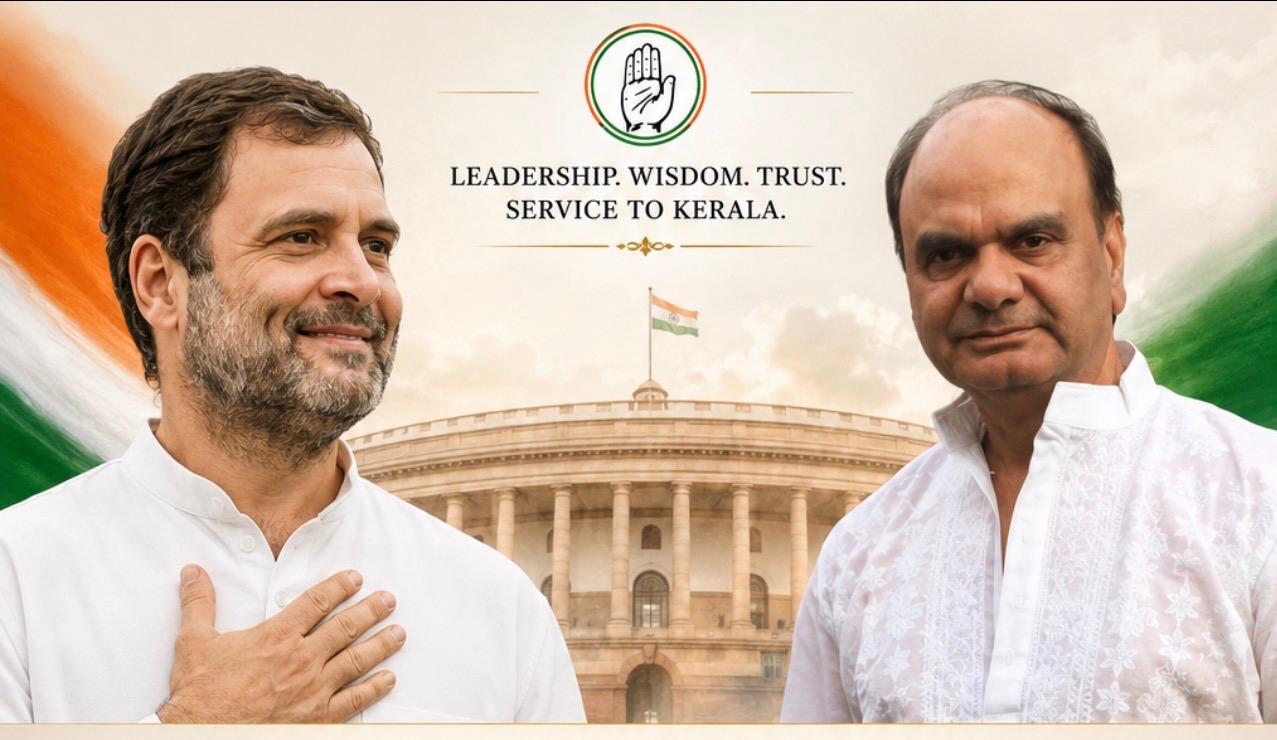
The Congress leadership’s backing of V.D. Satheesan in Kerala reflects a deeper political calculation: balancing generational change, factional equilibrium and ideological positioning in one of India’s most politically conscious states
ASHOK BHAN
The Congress leadership’s decision to back V.D. Satheesan as the party’s principal face in Kerala is more than an internal organisational adjustment. It reflects a carefully calibrated political strategy, shaped significantly by Rahul Gandhi’s evolving political judgment and his growing understanding of India’s changing electoral realities.
In many ways, the Kerala choice offers a revealing glimpse into the Congress party’s attempt to reconcile generational transition with organisational stability at a time when the opposition faces one of its most difficult phases in independent India’s history.
The phrase “balance of convenience” is often associated with judicial reasoning, where competing claims are weighed to determine an outcome that best preserves institutional stability and public interest. Rahul Gandhi appears to have applied a similar doctrine in Kerala.
The decision was neither impulsive nor entirely faction-driven. Instead, it emerged from a recognition that leadership choices in Kerala carry implications far beyond the state’s borders. They shape the Congress party’s national narrative on renewal, secularism, democratic accommodation and internal cohesion.
Kerala occupies a unique place in India’s political landscape. Unlike several states where elections are driven largely by caste equations or personality cults, Kerala’s electorate is politically conscious, highly literate and ideologically engaged.
Governance credibility, ideological consistency and administrative seriousness matter deeply to voters. Political transitions in Kerala are therefore not merely symbolic exercises. They become tests of a party’s capacity to understand social aspirations and institutional realities.
The Congress in Kerala has historically been home to powerful factions and influential leaders. From K. Karunakaran and Oommen Chandy to A.K. Antony and Ramesh Chennithala, the party’s evolution has always involved complex negotiations among competing ambitions, regional loyalties and community representations. Managing these internal equations has often been as challenging as confronting political rivals.
Against this backdrop, Rahul Gandhi’s role became decisive. His handling of the Kerala question demonstrates a visible transformation in his leadership style. Once caricatured by opponents as politically hesitant or inexperienced, Rahul Gandhi increasingly appears to have adopted a more consultative and strategic approach. He now seems more willing to listen, assess competing claims and make decisions rooted in long-term political calculations rather than short-term appeasement.
Choice Reflects Recognition
The choice of Satheesan reflected recognition of several political realities simultaneously. First, there was a growing public sentiment within Kerala that the Congress required generational renewal. Younger voters, urban middle classes and sections of the party cadre were looking for leaders who combined ideological clarity with communicative energy and organisational seriousness. Satheesan’s rise addressed that aspiration. Over the years, he established himself as an articulate opposition leader, an aggressive legislative voice and a sharp critic of the ruling dispensation.
Second, the Congress leadership appears to have understood that Kerala politics was entering a transitional phase. Senior leaders still command immense respect and political stature, but parties that postpone leadership renewal for too long often become prisoners of nostalgia rather than instruments of future aspirations. Rahul Gandhi seems to have appreciated that delaying transition indefinitely could weaken organisational momentum and alienate younger demographics.
Third, the decision reflected an attempt to preserve internal equilibrium within the Kerala Congress. Leadership selection in Kerala is never merely about choosing an individual. It involves balancing factions, communities, regions and organisational loyalties. Satheesan’s relative acceptability across different sections of the party made him a comparatively stable consensus figure. While every transition inevitably disappoints rival aspirants, the final decision avoided the impression of vindictive exclusion or abrupt marginalisation.
Rahul Gandhi’s political wisdom lay precisely in recognising that leadership legitimacy in Kerala cannot simply be manufactured through central imposition. It must emerge from a combination of public credibility, organisational confidence and ideological consistency. Satheesan had gradually built that profile over time. By endorsing him, Rahul Gandhi aligned the Congress high command with prevailing political sentiment instead of resisting it.
Another important dimension of the decision is ideological positioning. Kerala remains one of the few states where political discourse still revolves around secularism, welfare governance, constitutionalism and democratic rights. Rahul Gandhi’s politics over the past few years has increasingly emphasised constitutional morality, institutional accountability and social harmony. In Satheesan, he perhaps saw a leader capable of articulating those themes effectively within Kerala’s politically sophisticated environment.
This becomes particularly significant in the triangular ideological contest involving the Congress, the Left and the Bharatiya Janata Party. Although the BJP’s electoral footprint in Kerala remains limited, its ideological influence and political messaging continue to shape the state’s political debates. The Congress, therefore, requires leaders capable of simultaneously challenging the Left on governance and defending constitutional and secular values against aggressive polarisation. Satheesan’s legislative conduct and political language positioned him suitably for that role.
The delay in formally announcing the leadership decision attracted criticism from sections of the media and political observers. However, in coalition-driven and faction-sensitive politics, delayed decisions are not always signs of indecision. They may also reflect efforts toward broader consultation and consensus-building. Rahul Gandhi appears to have allowed internal discussions to mature before endorsing a final choice.
Internal Democracy
In that sense, the Kerala episode also highlights Rahul Gandhi’s evolving approach toward internal democracy within the Congress party. Unlike highly centralised command structures associated with several contemporary political parties, Rahul Gandhi has increasingly displayed a preference for consultative politics. Whether through state-level consultations, organisational elections or direct engagement with grassroots workers, he has attempted, though imperfectly, to revive participatory mechanisms within the party structure.
Critics may continue to argue that the Congress suffers from delays, ambiguity and factional tensions. Those criticisms are not entirely unfounded. Yet the Kerala decision demonstrates that Rahul Gandhi increasingly understands the importance of timing, optics and institutional balance. Politics is not merely about selecting the strongest claimant. It is about choosing the individual most capable of sustaining organisational cohesion while enhancing electoral credibility.
There is also a larger national significance to this decision. At a time when opposition politics in India is undergoing rapid reconfiguration, every Congress-ruled or Congress-influenced state carries symbolic importance. Leadership choices are closely watched for indications about the party’s future direction. By supporting a relatively younger and assertive leader like Satheesan, Rahul Gandhi sent a message that the Congress is willing to invest in generational change without entirely abandoning institutional continuity.
The decision also reflects Rahul Gandhi’s growing comfort with regional leadership autonomy. Contemporary Indian politics cannot be effectively managed solely from New Delhi. Regional aspirations, linguistic identities and state-specific political cultures require leaders with localised credibility. Kerala’s electorate has historically resisted excessive central interference. The Congress leadership appears to have recognised that a credible Kerala leader must emerge organically from the state’s own political environment.
Importantly, Satheesan’s emergence is not merely a personal victory. It represents a broader attempt by the Congress to redefine itself in Kerala after years of electoral uncertainty and leadership flux. The party understands that defeating entrenched political rivals requires both ideological clarity and organisational modernisation.
The Congress today faces enormous political challenges nationally. It confronts a powerful ruling establishment, organisational fatigue in several states and ideological attacks from multiple directions. In such circumstances, leadership decisions acquire strategic importance. Kerala was therefore not merely about identifying a future chief ministerial face. It was about signalling the party’s capacity for renewal, discipline and political maturity.
Rahul Gandhi’s handling of the Kerala question suggests increasing recognition that successful leadership transitions require patience, consultation and calibrated timing. He appears to have balanced competing interests without allowing factional conflict to spiral into open confrontation. The “balance of convenience” in this case was not opportunism. It was a pragmatic effort to preserve unity while advancing electoral effectiveness.
Whether Satheesan ultimately succeeds electorally will depend on governance narratives, organisational discipline, opposition strategies and voter sentiment. Yet the process leading to his emergence already offers valuable insight into Rahul Gandhi’s changing political persona. He appears increasingly willing to privilege institutional equilibrium over personal favouritism, generational transition over stagnation, and political practicality over rhetorical symbolism.
In the final analysis, the Kerala leadership choice underscores a larger democratic truth: durable politics depends on the ability to harmonise principle with pragmatism. Rahul Gandhi’s approach in Kerala reflects precisely such an attempt. By backing a leader who embodies credibility, energy and relative consensus, he reinforced the Congress party’s commitment to democratic accommodation and political balance.
The Kerala decision may therefore be remembered as more than a routine organisational announcement. It could mark an important stage in Rahul Gandhi’s evolution as a national political strategist, one increasingly aware that in a diverse democracy like India, political authority is sustained not merely through assertion, but through the wisdom to build consensus while steering change.
(The Author is a senior Congress leader and a noted senior advocate at the Supreme Court of India)