Mirza Ghalib in the Modern World: Why His Poetry Still Speaks to Our Age
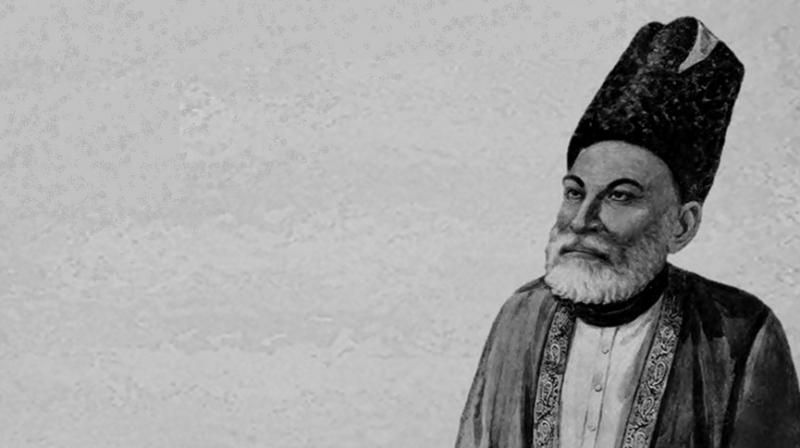
Ghalib continues to matter, not simply as an icon of Urdu literature, but as a poet for our troubled, searching, unfinished times
In every age of transition, societies return to voices that seem to understand the anxieties of being human more deeply than their own contemporaries do. Among such voices in South Asian literary history, few remain as enduring, penetrating, and intellectually alive as Mirza Asadullah Khan Ghalib. More than one and a half centuries after his death, Ghalib continues to inhabit public memory not merely as a canonical Urdu and Persian poet, but as a living presence in the moral, emotional, and philosophical life of the subcontinent.
His poetry is quoted in drawing rooms and classrooms, sung in ghazals and films, debated by scholars, and rediscovered by young readers searching for language adequate to loneliness, loss, ambition, irony, and doubt. The continued relevance of Ghalib in today’s world lies precisely in this extraordinary ability to speak across time: his verse emerges from the nineteenth century, but its concerns are unmistakably modern.
To regard Ghalib as merely a poet of romance is to diminish the breadth of his genius. Love in Ghalib is never confined to sentimental longing; it becomes a mode of inquiry into existence itself. The beloved in his poetry is often elusive, but so too is meaning, certainty, and fulfillment.
In an age such as ours marked by speed, fragmentation, social isolation, and emotional restlessness, Ghalib’s poetry offers not easy consolation, but recognition. He understands that human life is shaped by incompleteness. Desire persists because satisfaction remains deferred; hope survives because certainty does not. It is this endless structure of longing that Ghalib captured memorably in one of his most celebrated couplets:
Hazaron khvahishen aisi ke har khvahish pe dam nikle
Bahut nikle mire armaan lekin phir bhi kam nikle
The lines remain astonishingly relevant in the modern world. They speak to the culture of accumulation and aspiration that defines contemporary life, where every achievement gives rise to yet another desire. In an era of consumerism, digital comparison, and relentless ambition, Ghalib’s insight appears almost prophetic: human longing does not end with fulfillment; it only changes form. This is why modern readers, despite vast historical changes, still find themselves reflected in his verse. He gives form to the unfinished condition of human life.
One of the most striking aspects of Ghalib’s relevance today is his engagement with doubt. We inhabit a world that is technologically advanced but spiritually unsettled. People are more connected than ever before, yet often more alienated; they possess unprecedented access to information, yet remain uncertain about truth, purpose, and identity.
Ghalib’s poetry does not fear such uncertainty. On the contrary, it dwells within it. His verse repeatedly interrogates the self, fate, divine justice, and the contradictions of worldly existence. Rather than presenting fixed answers, he dramatizes the struggle to think and feel honestly in a world where certainties are fragile. That intellectual restlessness makes him profoundly contemporary.
In many ways, Ghalib may be described as a poet of consciousness. His greatness lies not only in lyrical beauty, but in his capacity to transform inner conflict into art. He does not conceal contradiction; he refines it. He is skeptical yet yearning, proud yet wounded, ironic yet sincere. Such complexity resonates strongly in the present era, when individuals often experience themselves as divided between public appearances and private vulnerability.
Social media culture, for instance, rewards performance, polish, and immediacy, but beneath these surfaces lie anxiety, inadequacy, and the burden of comparison. Ghalib’s poetic voice, with its self-awareness and ironic intelligence, reminds us that fractured interiority is not a modern invention, though it may have found new forms today. He speaks to those who smile outwardly while carrying storms within.
Equally important is Ghalib’s relevance to a time of civilizational and cultural transition. He lived through the decline of Mughal authority and witnessed the upheavals that transformed Delhi and the Indo-Muslim cultural world. His poetry and letters bear the imprint of a society confronting rupture, dispossession, and the erosion of inherited certainties. Our own age, though different in context, is similarly defined by transition.
Communities across the world grapple with displacement, political instability, cultural homogenization, and the pressures of modernity. In Kashmir, and indeed across South Asia, questions of memory, identity, and belonging are not abstract concerns; they are lived realities. Ghalib’s sensibility—formed in the shadow of historical collapse yet refusing surrender to silence—acquires particular significance in such settings. He teaches us that literature can preserve dignity amid disorder.
Another reason for Ghalib’s continued relevance is his language of grief. Modern life has normalized emotional suppression even as it generates new forms of distress. Economic uncertainty, conflict, loneliness, migration, and personal disconnection have deepened the need for a vocabulary of sorrow that is neither melodramatic nor sterile.
Ghalib provides precisely such a vocabulary. In his poetry, grief is not only an affliction; it is also a mode of self-knowledge. Pain refines perception. Loss enlarges consciousness. Suffering, though never romanticized simplistically, becomes an occasion for reflection on what it means to endure. This truth finds moving expression in another of his unforgettable couplets:
Dil hi to hai na sang-o-khisht, dard se bhar na aye kyun
Roenge ham hazaar baar, koi hamen sataie kyun
These lines affirm emotional vulnerability with rare grace. The heart is not made of stone or brick, Ghalib reminds us; why then should it not be overcome by pain? In an age that often demands emotional control and public composure, this couplet restores dignity to human sensitivity. It suggests that grief is not a defect to be hidden, but an inseparable part of our humanity. This is why his poetry often comforts readers not by removing sorrow, but by dignifying it. He tells us that to suffer is not to fail at living; it is to participate in life’s deepest reality.
Yet Ghalib is not a poet of despair alone. His work is illuminated by wit, playfulness, and a remarkable philosophical elasticity. Even at his most melancholic, he retains a capacity for irony that protects the self from collapse. This quality is especially valuable today, when public discourse is frequently polarized, humorless, and absolutist.
Ghalib’s irony is not cynicism; it is intelligence under pressure. It allows him to expose pretension, question orthodoxy, and resist rigid moralism without forfeiting seriousness. In a world increasingly divided by ideological certitude, such a voice remains indispensable. He demonstrates that subtlety is not weakness and that ambiguity can be a form of truth. This ironic perception appears brilliantly in the couplet:
Bazicha-e-atfaal hai duniya mere aagay
Hota hai shab-o-roz tamasha mere aagay
Here, Ghalib looks upon the world as a children’s playground, an endless spectacle unfolding before him day and night. The couplet reads today almost like a commentary on the performative culture of the digital age, where life is increasingly staged for visibility, applause, and distraction. Public life often appears as drama without depth, spectacle without reflection. Ghalib’s insight cuts through this illusion by exposing the triviality that sometimes underlies what the world takes most seriously.
Ghalib’s enduring appeal also owes much to his conception of individuality. He was deeply conscious of his own singularity, and this self-consciousness enters his poetry with unusual force. He does not dissolve the self into convention; he asserts its complexity. Modern readers, especially younger generations, are drawn to writers who speak from an authentic inwardness rather than inherited formula.
Ghalib’s verse carries precisely that impression of a mind thinking for itself. Even when working within the classical form of the ghazal, he stretches its expressive possibilities. He inherits tradition, but he does not submit to it mechanically. In this sense, he models a creative relationship with cultural heritage—one that preserves continuity without sacrificing innovation. This lesson is crucial today, when societies often oscillate between uncritical traditionalism and rootless modernism.
His importance is equally literary. Contemporary readers return to Ghalib because his poetry rewards rereading. It is layered, compressed, suggestive, and open to interpretation. A single couplet can sustain multiple meanings—emotional, metaphysical, theological, and psychological. Such richness explains why he remains central not only to popular culture but to serious literary scholarship. In an age of instant consumption, Ghalib reminds us of the value of difficulty. He asks readers not merely to feel, but to think. His poetry slows the mind down. It compels attention, nuance, and interpretive patience—habits increasingly endangered in a distracted age.
For Kashmir and for the broader Urdu-reading world, Ghalib’s relevance carries an additional cultural meaning. Urdu itself, despite its vast literary inheritance, often finds itself marginalized in public policy, educational priorities, and market-driven cultural life. To revisit Ghalib, therefore, is not only to celebrate an individual poet but to reaffirm a civilizational tradition of linguistic elegance, intellectual depth, and emotional subtlety. His poetry becomes a bridge between generations, linking younger readers to a shared literary past while also proving that classical literature is not antiquarian ornament but a resource for understanding the present.
This is especially important for newspapers and public forums of opinion. In a time when public language is increasingly reduced to slogans, outrage, and superficial commentary, Ghalib offers another model of expression—measured yet intense, refined yet intimate, critical yet humane. He reminds writers and readers alike that language matters, that precision of feeling matters, and that the inner life deserves serious articulation. An intellectually healthy society cannot survive on information alone; it requires imagination, memory, and moral reflection. Poetry, at its best, nourishes these capacities. Ghalib remains one of its greatest custodians.
It is also worth noting that Ghalib’s relevance is not limited to those already trained in literary appreciation. His popularity among ordinary readers, listeners, and audiences suggests that his appeal rests on more than academic prestige. He survives because he articulates universal experiences in a language of uncommon beauty. The tensions between desire and restraint, faith and skepticism, selfhood and society, suffering and endurance—these are not historical curiosities. They are permanent features of the human condition. Ghalib’s greatness lies in revealing their depth without reducing their mystery.
In the final analysis, Mirza Ghalib remains relevant today because he speaks to both the wounds and the intelligence of modern humanity. He does not flatter his reader with false hope, nor overwhelm them with nihilism. Instead, he offers companionship in complexity. He teaches us how to inhabit uncertainty without surrendering thought, how to endure sorrow without losing wit, and how to remain inwardly alive amid historical and personal upheaval. For a world increasingly loud yet inwardly fragile, his poetry is not a relic of the past but a guide to emotional and intellectual survival.
That is why Ghalib continues to matter—not simply as an icon of Urdu literature, but as a poet for our troubled, searching, unfinished times. The world has changed beyond recognition since his Delhi, but the human heart, with its longing, contradictions, vanities, and wounds, remains recognisably the same. And as long as that is true, Ghalib will remain our contemporary.
(The Author is a PhD in English Literature and has a strong passion for Urdu poetry)
Related Posts
-

The Cost of Our Lifestyle Choices
-

Fear, Fuel, and the Politics of Perception
-

The Architect of Mu’amila-Bandi: Momin Khan Momin and the Poetics of Romantic Realism
-

Is Healthcare Sector shifting from Service-Oriented Care to Profit-Driven Practice?
-

Vanishing Wetlands in Kashmir
-

It’s The Driving Sense That Can Save Lives…!
-

Bridging the Awareness Gap and the AI-Driven Future of Mobility in Jammu & Kashmir
-

Sir Syed Sani: A Legacy of Knowledge, Unity, and Moral Authority
-

A Day of Bills and Backtracks: What NC’s Assembly moves Reveal about Legislative Intent
-

Why our Elders deserve Care, Love, and a Place at the Heart of Society
-

The Need for Corporate Social Responsibility in Kashmir Valley
-

The Plague Doctor of Islamabad
-

The Phenomenon of a Rolling Aspirant: A gentle plea to rethink career switching
-

Gender Neutral Representation in Jammu And Kashmir’s Textbooks: The Reform that Can’t Wait
-

The Dying Art of Houseboat Making
Leave a comment