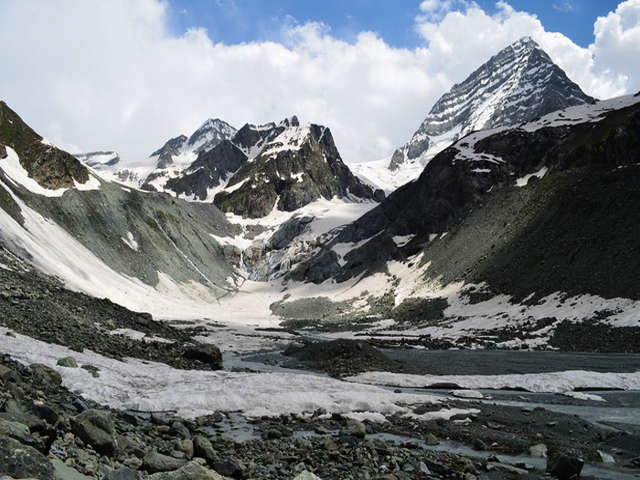
Melting Glaciers:Kolahoi Glacier, ‘crown of Kashmir’, melting at alarming rate
-
 Abid Bashir
- Comments 0
- 04 May 2026
• −0.95 metres lost yearly (1980-2019) • 1°C temp rise = 0.65m extra loss • 2000-2010 recorded worst melt • Warmer summers, less snow driving loss • Lidder River, Jhelum system at risk • Region's water security in danger
Srinagar, May 03: The iconic Kolahoi Glacier, often described as the “crown of Kashmir”, is undergoing rapid and sustained melting, raising serious concerns about the region’s long-term water security.
A detailed study conducted by the University of Kashmir (KU) has revealed that the glacier has been losing mass at an alarming rate over the past four decades, driven largely by rising temperatures and changing precipitation patterns.
The study, titled “Direct, geodetic and simulated mass balance studies of the Kolahoi Glacier in the Kashmir Himalaya”, has been led by Prof Shakil Ahmad Romshoo along with researchers Tariq Abdullah, Khalid Omar Murtaza and Mustafa Hameed Bhat from KU's Department of Geoinformatics.
“This is one of the most comprehensive assessments of glacier health in the Kashmir Himalaya,” the study notes, highlighting that Kolahoi has experienced consistent mass loss since 1980, with the rate of melting accelerating in recent decades.
According to the findings, the glacier lost an average of nearly −0.95 meters of water equivalent per year between 1980 and 2019. More recent field-based measurements from 2014 to 2019 show an average loss of −0.83 ± 0.34 metres annually, confirming that the glacier continues to shrink at a worrying pace.
Prof Romshoo and his team used a combination of field observations, satellite data and climate-based modelling to reconstruct the glacier’s behaviour over nearly 40 years. “All three approaches—direct measurements, geodetic analysis and simulations—show strong agreement, reinforcing the reliability of the findings,” the study states.
The research identifies temperature as the dominant driver of glacier melt. “The mass balance is highly sensitive to temperature changes, with a 1°C rise leading to an additional loss of about −0.65 meters water equivalent annually,” the study explains. In contrast, changes in precipitation have a relatively minor impact, with even a 10 per cent increase resulting in only marginal gains.
“The historical reconstruction reveals four distinct phases of glacier behaviour,” the study notes. The 1980s witnessed relatively low mass loss, even recording a few years of positive balance. However, the situation deteriorated sharply in the following decades, particularly between 2000 and 2010, which recorded the highest rate of mass loss at −1.18 meters per year.
Researchers attribute this acceleration to a combination of warmer summers and reduced winter snowfall. “Years with higher summer temperatures and lower winter precipitation correspond closely with increased glacier melt,” the study observes.
The implications of Kolahoi’s retreat extend far beyond the glacier itself. Located in the Upper Indus Basin, the glacier feeds the Lidder River, which ultimately contributes to the Jhelum River system—a critical water source for agriculture, hydropower and domestic use.
“Glacier mass loss is expected to exacerbate under projected climate change, which will further diminish streamflow in transboundary rivers,” the authors warn.
The study also highlights the broader vulnerability of the Himalayan region, often referred to as the “Water Tower of Asia,” where millions depend on glacier-fed rivers. Despite this dependence, the researchers point out significant gaps in data and monitoring.
“Only a handful of glaciers in the Indian Himalaya have long-term mass balance records, making studies like this crucial for understanding regional climate impacts,” the paper notes.
Prof Romshoo emphasised that the findings should serve as a wake-up call for policymakers. “Understanding glacier dynamics is essential for planning sustainable water management strategies in a changing climate,” the study underlines. As climate change continues to intensify, the fate of Kolahoi Glacier stands as a stark reminder of the fragile balance between nature and human survival. The silent retreat of this Himalayan giant is not just an environmental concern—it is a looming crisis for the millions who depend on its waters.
Related Posts
-

J&K’s Ranji win proud moment: PM Modi
-

Jammu Marathon symbolises J&K’s transformation: LG Sinha
-

Physical fitness integral to societal progress: CM Omar
-

J&K dairy grows 15%, but 7.4% samples fail safety tests
-

Kashmir’s rooftops power new energy dawn
-

Payroll Without Purpose
-

Self-styled journalists misusing platform, MLA Uri in assembly
-

Omar Abdullah urges ceasefire, calls on PM Modi to mediate Iran crisis
-

LG Sinha suspends Anantnag ADC, reassigns officer to Div Com Kashmir
-

LG, CM greet people on Mahavir Jayanti
-

J&K Govt orders transfers, postings
-

Govt to review District Planning Boards framework
-

150th Anniversary Closing Ceremony : Vande Mataram our identity, strength & vow: LG Sinha
-

Mission YUVA should become national benchmark: CM
-

LG assents to three Bills passed by LA

Leave a comment