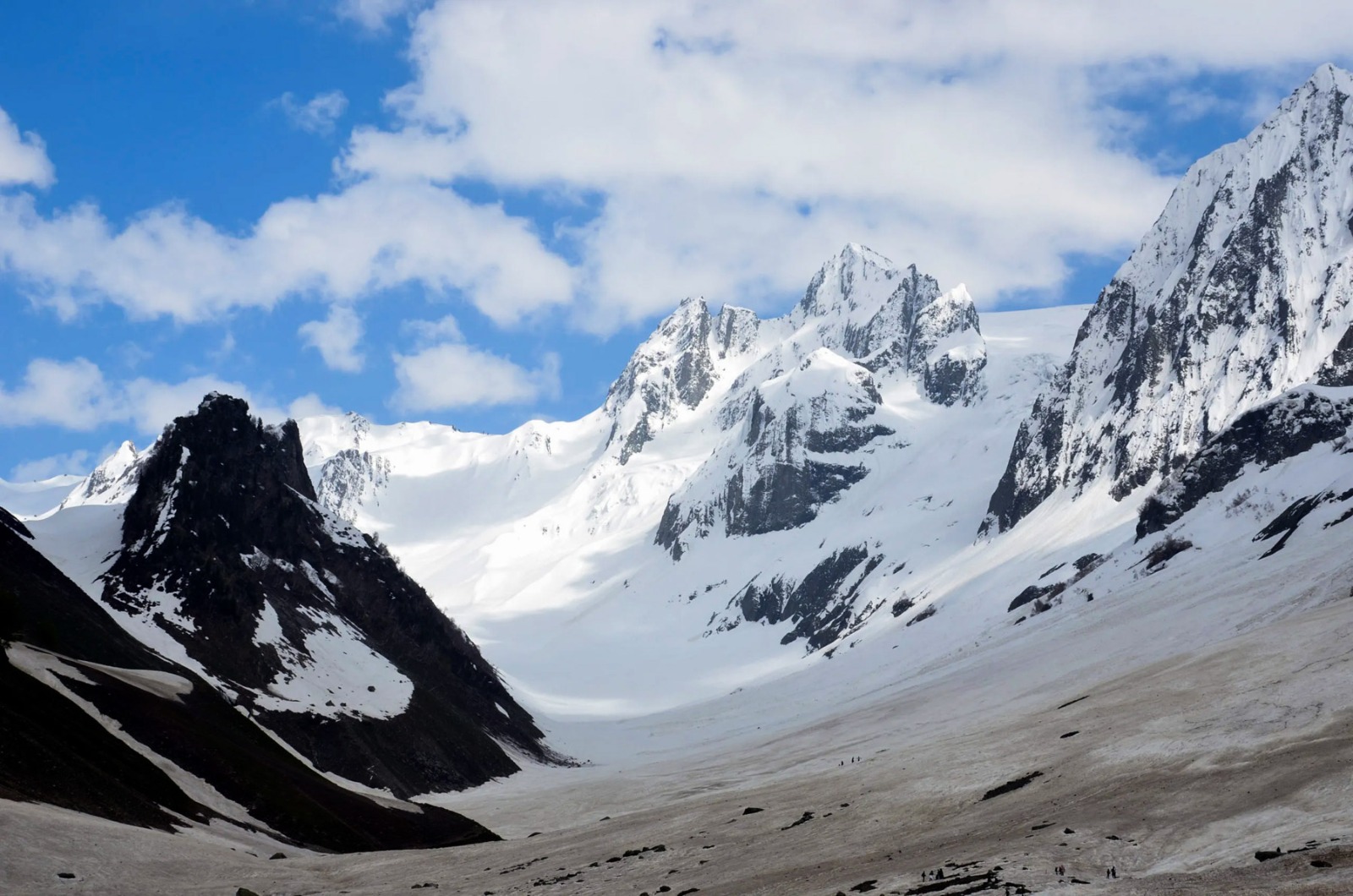
Melting Glaciers: Part 6 :Kashmir’s iconic glacier Thajwas loses 88% ice volume
-
 Abid Bashir
- Comments 0
- 11 May 2026
‘Himalayan landscape undergoing dramatic transformation’ KU STUDY HIGHLIGHTS • 88% ice volume lost • Area shrunk from 15.43 to 3.60 sq km • Equilibrium line up 1,300 metres • Satellites, GPS, field surveys used • Glacier now in upper cirques • Moraines, cirques, troughs mapped • Glacier once stretched 7.5 km downstream
Srinagar, May 10: Thajwas, one of Kashmir’s most iconic glaciers, has lost nearly 88 per cent of its ice volume over time, offering fresh evidence of the dramatic climatic and environmental changes reshaping the Himalayan region, a significant scientific study by the researchers from Kashmir University has revealed.
The study, titled “Glacial-geomorphic study of the Thajwas glacier valley, Kashmir Himalayas, India”, was carried out by researchers from the Department of Earth Sciences, University of Kashmir, including Prof Shakil Ahmad Romshoo, Khalid Omar Murtaza and other scientists.
Published in the international journal Quaternary International, the research presents a detailed reconstruction of the ancient glacial history of the famous Thajwas glacier valley in Sonamarg using satellite imagery, digital elevation models, field surveys and geomorphological mapping.
The findings paint a stark picture of glacier retreat in the Kashmir Himalayas.
According to the study, the Thajwas glacier once covered nearly 15.43 square kilometres during its major glacial advance but has now shrunk to just 3.60 square kilometres — reflecting an area loss of almost 81 per cent. In terms of ice volume, researchers estimate the glacier has lost nearly 88 per cent of its mass.
“The glacier has receded drastically over time, and the evidence preserved in the valley clearly reflects repeated climatic fluctuations during the Late Quaternary period,” the study notes.
Researchers found well-preserved glacial landforms, including terminal moraines, cirques, glacial troughs, hanging valleys and meltwater channels, all of which helped scientists reconstruct the glacier’s ancient extent and movement.
According to the study, the Valley bears unmistakable signatures of repeated glaciations and interglacial warming phases over thousands of years.
One of the most striking findings of the research is the upward shift in the Equilibrium Line Altitude (ELA) — the point where snow accumulation and melting remain balanced. Scientists found that the ELA has shifted upward by nearly 1300 metres over time, indicating significant warming and retreat of glacial systems.
The researchers noted that glaciers in the Kashmir Himalayas are particularly vulnerable because they depend heavily on snowfall brought by western disturbances during winter and spring.
“Recent studies suggest that glaciers in the Kashmir Himalayas are depleting at varying rates and the recession is mainly attributed to the recent warming observed in the region,” the study noted.
Using high-resolution Google Earth imagery, Landsat satellite data and ASTER digital elevation models, the team mapped glacial features across the Thajwas valley and validated them through GPS-based field observations and ground photography.
The study also highlights how glacier retreat has transformed the physical landscape of the region. Scientists observed widening of the glacial valley, retreat of cirques and changes in drainage patterns caused by long-term glacial erosion and melting.
“The concomitant retreat of the north-facing glacial cirques has played an important role in expanding the glacial valley and limiting the topographic relief,” the researchers wrote.
The findings assume significance at a time when Jammu & Kashmir is witnessing repeated weather anomalies, shrinking snow reserves and prolonged rainfall deficits, raising fresh concerns over future water security in the Himalayan region.
Scientists warn that continued glacier recession could eventually impact stream flows, river discharge, groundwater recharge and hydroelectric power generation across Kashmir, where snow-fed systems remain the backbone of water supply.
The study further notes that the Kashmir Valley has witnessed repeated climatic shifts during the Late Quaternary period, preserved in the form of glacial deposits, lake sediments and loess-palaeosol sequences across the region.
Researchers stressed that glacial landforms across the Kashmir Himalayas offer valuable evidence for understanding past climate variability and predicting future environmental risks linked to global warming.
Related Posts
-

J&K’s Ranji win proud moment: PM Modi
-

Jammu Marathon symbolises J&K’s transformation: LG Sinha
-

Physical fitness integral to societal progress: CM Omar
-

J&K dairy grows 15%, but 7.4% samples fail safety tests
-

Kashmir’s rooftops power new energy dawn
-

Payroll Without Purpose
-

Self-styled journalists misusing platform, MLA Uri in assembly
-

Omar Abdullah urges ceasefire, calls on PM Modi to mediate Iran crisis
-

LG Sinha suspends Anantnag ADC, reassigns officer to Div Com Kashmir
-

LG, CM greet people on Mahavir Jayanti
-

J&K Govt orders transfers, postings
-

Govt to review District Planning Boards framework
-

150th Anniversary Closing Ceremony : Vande Mataram our identity, strength & vow: LG Sinha
-

Mission YUVA should become national benchmark: CM
-

LG assents to three Bills passed by LA

Leave a comment