Melting Glaciers: Part 5 :Lidder Valley glaciers shrink 17% in 30 years
-
 Abid Bashir
- Comments 0
- 09 May 2026
KU STUDY HIGHLIGHTS • Snowlines rose 280m • Kashmir could warm 6°C+ • Rivers, farms, power at risk • Black carbon accelerating ice loss
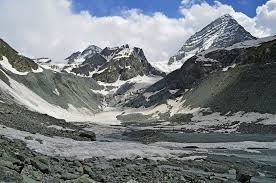
Srinagar, May 08: A comprehensive scientific study conducted on the Kashmir Himalayas has revealed a worrying decline in glacier health, with glaciers in the Lidder Valley shrinking by nearly 17 per cent over the past three decades amid rising temperatures and changing climatic conditions.
The study, titled “Recent Glacier Changes in the Kashmir Alpine Himalayas”, was carried out by researchers Prof Shakil A. Romshoo and Khalid Omar Murtaza from the Department of Earth Sciences at the University of Kashmir (KU). Published in the journal Geocarto International, the research used satellite data spanning from 1980 onwards to assess glacier fluctuations across nine benchmark glaciers in the Lidder basin.
Using multi-temporal Landsat satellite imagery and ASTER digital elevation models, the researchers mapped changes in glacier area, equilibrium line altitude (ELA), and specific mass balance (SMB) — all critical indicators of glacier stability and climate response.
According to the study, glaciers in the region have shown “significant recession and mass loss,” with the equilibrium line altitude shifting upward by nearly 280 to 300 metres during the study period. Scientists say this upward migration of snowlines is a strong indicator of warming climatic conditions and reduced ice accumulation.
“The observed changes in glacier geometry and dynamics, if continued, shall have adverse effects on streamflows, water supplies and other dependent sectors in the region,” the study warned.
The research found that annual air temperatures in the Kashmir Himalayas showed a significant increasing trend over the last three decades, while precipitation registered a slight but statistically insignificant decline. Scientists noted that rising temperatures were emerging as the dominant driver behind glacier retreat.
Outside the Polar Regions, the Himalayas contain one of the largest concentrations of ice on Earth and serve as the water tower for major Asian river systems, including the Indus, Ganga and Brahmaputra. In Kashmir, glaciers feed numerous rivers and streams that sustain drinking water supplies, agriculture, horticulture and hydroelectric power generation.
The study focused on glaciers in the Lidder Valley of south Kashmir, an ecologically sensitive region known for its snow-fed rivers and alpine water systems. The valley hosts major glaciers, including the Kolahoi Glacier in west Lidder and the Shishram Glacier in east Lidder.
Researchers observed that despite existing under similar climatic conditions, glaciers responded differently depending on topographic characteristics such as altitude, slope, orientation and debris cover.
“It is evident that in the same climatic regime, varying topography plays a key role in determining glacier changes,” the researchers noted, highlighting that local terrain can either accelerate or slow down melting patterns.
The study also referred to broader climate projections for the Himalayan region, citing estimates that temperatures in the Indian subcontinent could rise between 3.5°C and 5.5°C by the end of the century, while the Kashmir Himalayas alone could witness temperature increases exceeding 6°C.
Scientists warned that continued glacier recession could have cascading impacts across the Himalayan ecosystem. Reduced glacier mass initially increases river discharge due to accelerated melting, but long-term depletion eventually threatens water availability, especially during dry seasons.
The study linked glacier decline not only to climate change but also to anthropogenic influences such as black carbon emissions and environmental degradation. It noted that Himalayan glaciers have been retreating since the end of the Little Ice Age, but the pace of retreat has accelerated sharply in recent decades.
To map glacier changes, researchers employed advanced remote sensing techniques including Normalised Difference Glacier Index (NDGI), band ratioing and visual interpretation of satellite imagery. Field verification using GPS surveys was also carried out to validate glacier snout positions and ice boundaries.
Experts say studies like these are crucial for understanding future climate risks in Kashmir, where glacier-fed rivers form the backbone of rural livelihoods and mountain ecology.
The findings come amid growing scientific concern over rapid cryospheric changes across the Himalayas, often described as the “Third Pole” because of its vast ice reserves after Antarctica and the Arctic.
With glaciers continuing to recede and temperatures steadily climbing, scientists warn that the Kashmir Himalayas may be entering a period of irreversible environmental transformation unless global and regional climate mitigation efforts are strengthened.
Related Posts
-

J&K’s Ranji win proud moment: PM Modi
-

Jammu Marathon symbolises J&K’s transformation: LG Sinha
-

Physical fitness integral to societal progress: CM Omar
-

J&K dairy grows 15%, but 7.4% samples fail safety tests
-

Kashmir’s rooftops power new energy dawn
-

Payroll Without Purpose
-

Self-styled journalists misusing platform, MLA Uri in assembly
-

Omar Abdullah urges ceasefire, calls on PM Modi to mediate Iran crisis
-

LG Sinha suspends Anantnag ADC, reassigns officer to Div Com Kashmir
-

LG, CM greet people on Mahavir Jayanti
-

J&K Govt orders transfers, postings
-

Govt to review District Planning Boards framework
-

150th Anniversary Closing Ceremony : Vande Mataram our identity, strength & vow: LG Sinha
-

Mission YUVA should become national benchmark: CM
-

LG assents to three Bills passed by LA

Leave a comment