J&K to roll out long-term rehab plan for drug victims
-
 RK News
- Comments 0
- 09 May 2026
Three-year framework; 30-40 trained mentors per district
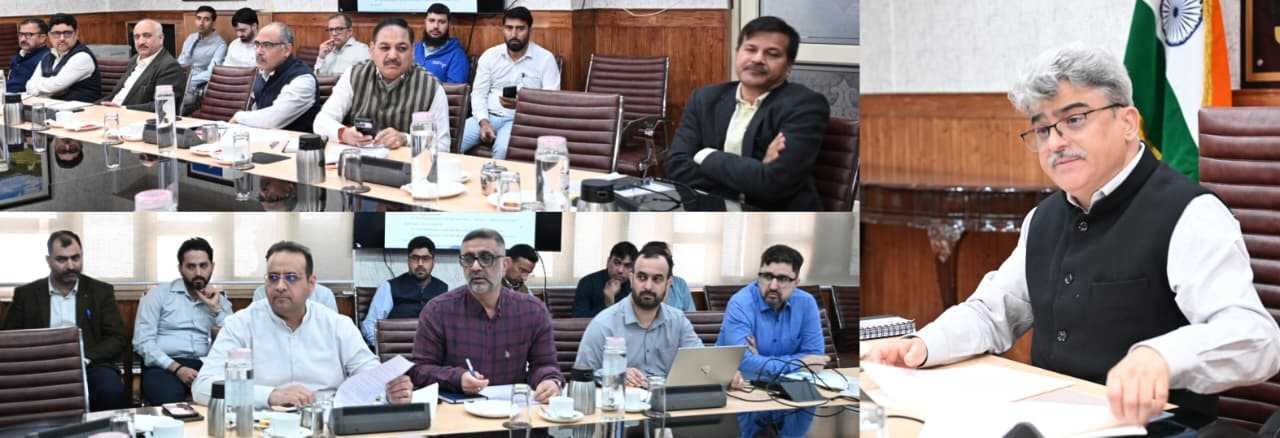
Srinagar, May 08: Chief Secretary Atal Dulloo on Friday chaired a meeting of the concerned Administrative Secretaries to deliberate upon the comprehensive rehabilitation plan for victims of drug abuse prepared by the Social Welfare Department in consultation with various government departments and stakeholders.
The meeting was attended by Additional Chief Secretary, Finance; Principal Secretary, Home; Commissioner Secretary, General Administration Department; Commissioner Secretary, Social Welfare Department; Commissioner Secretary, School Education Department; Director Colleges; State Informatics Officer, NIC; and other senior officers.
During the meeting, the Chief Secretary underscored the need for devising a highly effective and practical rehabilitation strategy capable of yielding tangible outcomes on the ground. "The plan should be further fine-tuned through detailed consultations with all concerned departments and civil society stakeholders, particularly professionals from the Institute of Mental Health and Neurosciences (IMHANS) and Psychiatry Departments of Government Medical Colleges," he said.
Highlighting the critical role of patient mentors in the rehabilitation process, Dulloo observed that such mentors should possess some basic qualifications and undergo specialised training modules at IMHANS. He called for the creation of a dedicated pool of trained resource persons, with at least 30 to 40 mentors identified in each district, to support the long-term rehabilitation initiative.
The CS said that a cadre of committed and professionally trained mentors would form the bedrock of the rehabilitation programme. "The responsibilities of mentors should be clearly defined in accordance with the individual needs of patients so that they are able to effectively engage with them and play a pivotal role in their sustained rehabilitation and reintegration into society," he said. He directed that an appropriate incentive mechanism be devised to motivate and encourage these mentors.
Dulloo further stressed the importance of dovetailing government schemes and resources for providing livelihood opportunities to rehabilitated individuals, including skill development for self-employment and facilitating their return to schools and colleges to continue their education. He asked NIC to develop a dedicated digital portal for sustainable monitoring of the rehabilitation process and long-term stabilisation of affected individuals within the social milieu.
Calling for a comprehensive framework with clearly defined roles and responsibilities for every associated department and stakeholder, the Chief Secretary directed that all financial implications and expected outcomes over a specified period be worked out in detail to ensure effective implementation of the programme.
Additional Chief Secretary, Finance, Shailendra Kumar, emphasised categorisation of patients on the basis of the severity of addiction so that mentorship and rehabilitation interventions are tailored accordingly. He also suggested exploring financial support through Corporate Social Responsibility (CSR) initiatives as well as government funding mechanisms, for the successful execution of the programme.
He further advised the identification and utilisation of psychologists available across different departments, including the Higher Education and Health Departments, to strengthen counselling and rehabilitation services.
Principal Secretary, Home, Chandraker Bharti, stressed the need for designing the rehabilitation structure after careful assessment of ground-level requirements. He observed that the programme should not merely replicate conventional government schemes but instead be shaped around the specific needs, aspirations and challenges faced by the victims and their families.
Earlier, Commissioner Secretary, Social Welfare Department, Sarmad Hafeez, gave a detailed presentation on the preliminary rehabilitation plan prepared by the department after extensive consultations with various stakeholders and departments.
He informed the meeting that Jammu and Kashmir is emerging as the first region in the country to work on a structured long-term rehabilitation model for drug abuse victims, focusing not only on treatment but also on stabilisation, social reintegration and livelihood support to prevent relapse after treatment.
Outlining the proposed three-year structured rehabilitation framework, he said that the plan is based on the principles of treatment and stabilisation, followed by reintegration, livelihood generation, post-care monitoring and social inclusion.
The Commissioner Secretary further informed that the strategy envisages empanelment of patient mentors for continuous counselling, guidance and emotional support. He also elaborated upon the proposed monitoring and supervision mechanism at the Union Territory, divisional and district levels to ensure effective implementation and achievement of the intended objectives without deviation.
He also presented the detailed framework for post-care monitoring and livelihood support through various government programmes and schemes, besides explaining the timelines proposed for different phases of the rehabilitation exercise.
Related Posts
-

J&K’s Ranji win proud moment: PM Modi
-

Jammu Marathon symbolises J&K’s transformation: LG Sinha
-

Physical fitness integral to societal progress: CM Omar
-

J&K dairy grows 15%, but 7.4% samples fail safety tests
-

Kashmir’s rooftops power new energy dawn
-

Payroll Without Purpose
-

Self-styled journalists misusing platform, MLA Uri in assembly
-

Omar Abdullah urges ceasefire, calls on PM Modi to mediate Iran crisis
-

LG Sinha suspends Anantnag ADC, reassigns officer to Div Com Kashmir
-

LG, CM greet people on Mahavir Jayanti
-

J&K Govt orders transfers, postings
-

Govt to review District Planning Boards framework
-

150th Anniversary Closing Ceremony : Vande Mataram our identity, strength & vow: LG Sinha
-

Mission YUVA should become national benchmark: CM
-

LG assents to three Bills passed by LA

Leave a comment