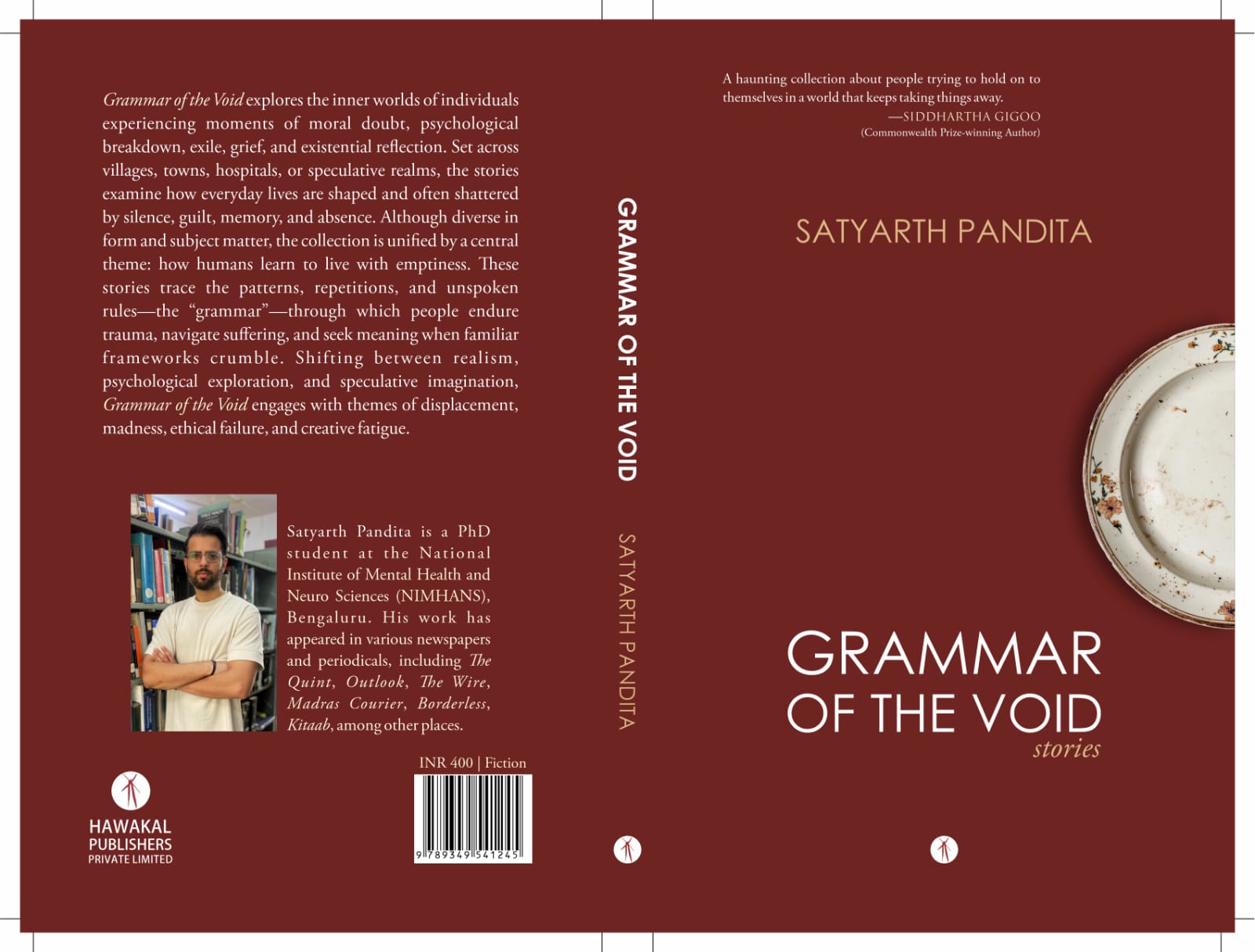
“GRAMMER OF THE VOID”: Exploring The Centrality Of Human Existence
-
 COL SATISH SINGH LALOTRA
- Comments 0
- 09 May 2026
The book is a masterpiece creation exploring the innermost recesses of a human being's mind in so far as his emotions are concerned
BOOK REVIEW
There are silences that pass unnoticed and there are silences, that shape us. “Grammar of the void " was born from the latter--- the kind that lingers on in the spaces between words, in the pauses we do not acknowledge and in the histories we inherit of humans without consent. This masterpiece of literary creation penned by a young, budding Kashmiri writer Sathyart Pandita is the son of acclaimed author Deepak Raj who has penned a book, "In the wanderland" and a fast friend of mine.
I was relatively unknown of the fact that a book release of this nature was planned, until I got a call from Deepak Raj a few days back to make myself available on 26th April 2026 at the Writer's club in Jammu in the premises of JKAACL( JAMMU AND KASHMIR ACADEMY OF ARTS CULTURE AND LANGUAGES) .
Having come from Pune for a few days to Jammu (Home town), Deepak Raj knew that time was at premium for me and hence wanted my presence at this august gathering before I flew back. There are books that inform and then there are books that bear witness. "Grammar of the void" by Sathyart Pandita belongs to that genre of books which stand testimony to events still having their reverberations felt in the valley part of Jammu and Kashmir.
Comprising of ten short stories, the collection turns its gaze towards one of the most painful chapters in recent Kashmiri history ---the displacement of the KPs from their homeland in the 1990s with concomitant effects. This displacement of one of most important segments of Kashmiri populace albeit couched in myriad human sufferings forms the core of the ten stories of this book.
Ranging from a profound sense of self-doubt , psychological breakdown, exile, grief and existential reflection the book exposes a reader to the countless human emotions intertwined in a mesh but bound in one single mosaic of humanity in its most vulnerable moments. The author has set all these short stories in a cross section of vistas spanning villages, towns, hospitals, cities etc. These stories reveal and examine how everyday lives are torn asunder by forces unleashed from places that are remotely concerned with these people.
The subtle overcoming of silence, guilt, shame, memory and absence overshadows these stories where human being is the main protagonist fighting tooth and nail his or her emptiness in life. Sathyart Pandita does not attempt a sweeping historical account. Instead he chooses intimacy over scale.
Each story unfolds through individual lives marked by loss, uncertainty and the slow often invisible process of rebuilding. The strength of this book lies in its restraint, it avoids overt dramatization allowing the quiet devastation of exile to speak for itself couched in countless human emotions.
These stories do not unfold loudly. They move with the quietude and persistence of memory --- returning, receding and yet returning again. Homes are remembered in fragments, relationships stretch across distances often marred with a defeaning silence of emptiness. And identities find themselves suspended between what was and what can no longer be reclaimed.
Pandita's void is not an absence but a presence--- done with memory, silence and the unknown grief when a community is unhinged from its roots. There is no attempt to restore history or to soften its edges. Instead the book dwells in its incompleteness. Incompleteness of human fulfilment wherein each story stands as a testament to lives interrupted , yet enduring.
The "void" of the title by Pandita is neither abstract nor distant---it is lived, carried and negotiated everyday by those who were uprooted. Shifting between realism, psychological exploitation and speculative imagination, Grammar of the void engages with themes as explained by me above in manners not seen or heard from a young writer as enunciated by Sathyart Pandita. All of 27 years, he belies his age, when stories of his creation are sunk in the hearts and minds of his countless readers.
Released at a gala level on the 26th April 2026 at Writer's club Jammu in the presence of a galaxy of intellectuals, educationists, academicians and social activists the show was emblazoned by the attendance of Rajya Sabha MP and state president of BJP Sat Sharma who eulogised the young budding writer in as many words as possible. While as Bureau chief of Daily excelsior Sanjeev pargal, and secretary Kala kendra Javed Rahi along with Prof Vandana Sharma dean school of languages, CUJ, Jammu and Sham Narayan Lal of IIM Jammu with their special presence highlighted the academic quotient of the show.
Since I too was part of the invite to this book release function, self was witness to the address of the chief guest MP Sat Sharma who eulogised young Sathyart Pandita in as many ways as possible for taking the leap into the literary world at such an impressionable age. Drawing parallels between world renowned Kashmiri writers like Kalhan, and Acharya Abhinav Gupta and others, Javed Rahi in his address regaled the select gathering with his choicest Urdu couplets saying that in today's world of internet and you tube , books are here to stay for eternity.
Prof Vandana Sharma and Sham Narayan Lal read their respective papers, keeping the released book at the core of their discourses. Publisher Kirti Sen Gupta and Bitan Chakravarty of "Hawakal Publishers", Kolkata, also graced the occasion and participated in the introductory session with the author to know who inspired him to write such a masterpiece of a book at his age.
The icing on the cake of this whole book release programme was the presence of all near and dear ones of the author, Sathyart Pandita, on this occasion. A refreshing aspect of this book release was the author giving full credit to his grandfather, Badri Nath Pandita, for initiating him into the world of literature. In today's crumbling society, where grandparents are living on the margins, here was a Sterling example of a grandfather hogging the limelight.
The welcome address, true to the spirit of the event, was given by the grandfather of the author, with Mr Ravindra Koul ( art critic) conducting the entire event and proposing a vote of thanks. Priced at Rs 400 only, Pandita's first book is a must-buy for both amateur and professional readers.
The book is a masterpiece, exploring the innermost recesses of a human being's mind insofar as his emotions are concerned. To read this collection is not simply to engage with fiction; it is to encounter a truth that continues to shape the present quietly but insistently.
(The writer is a retired army officer and a regular scribe of Rising Kashmir. He can be approached at his email....Slalotra4729@gmail.com)
Related Posts
-

The Cost of Our Lifestyle Choices
-

Fear, Fuel, and the Politics of Perception
-

The Architect of Mu’amila-Bandi: Momin Khan Momin and the Poetics of Romantic Realism
-

Is Healthcare Sector shifting from Service-Oriented Care to Profit-Driven Practice?
-

Vanishing Wetlands in Kashmir
-

It’s The Driving Sense That Can Save Lives…!
-

Bridging the Awareness Gap and the AI-Driven Future of Mobility in Jammu & Kashmir
-

Sir Syed Sani: A Legacy of Knowledge, Unity, and Moral Authority
-

A Day of Bills and Backtracks: What NC’s Assembly moves Reveal about Legislative Intent
-

Why our Elders deserve Care, Love, and a Place at the Heart of Society
-

The Need for Corporate Social Responsibility in Kashmir Valley
-

The Plague Doctor of Islamabad
-

The Phenomenon of a Rolling Aspirant: A gentle plea to rethink career switching
-

Gender Neutral Representation in Jammu And Kashmir’s Textbooks: The Reform that Can’t Wait
-

The Dying Art of Houseboat Making

Leave a comment