Thread by thread, year by year : The ‘Dharam Veer’ Rafoogars of Zadibal who bring dead carpets back to life
-
 Ada Bhat
- Comments 0
- 06 May 2026
Abdul Hameed Dar & Altaf Ahmad Sopori hope for govt support to sustain fading craft
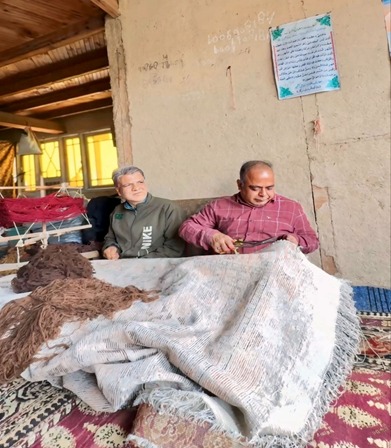
In Zadibal, Srinagar, a friendship woven over three decades has endured as finely as the carpets they restore. Abdul Hameed Dar and Altaf Ahmad Sopori, fondly known as “Daram Veer Ki Jodi”, have spent more than 30 years together practising the delicate and demanding art of Rafoogari, or carpet darning.
Trained under the legendary yet strict master Ali Mohammad Dar, the duo entered a craft many were too hesitant to pursue. It demanded patience, discipline, and years of quiet learning. Over time, they mastered it, transforming what once seemed intimidating into a lifelong skill and shared identity. Much like the carpets they restore, their friendship too has been carefully maintained thread by thread, year after year.
From a small workshop within their home, they now repair carpets from Kashmir, Iran, Belgium, and beyond. Many of these pieces arrive in a state that families believe is beyond repair. But in the hands of Dar and Sopori, even the most damaged carpets are brought back to life.
Rafoogari is more than simple stitching. It requires the precision of a craftsman and the eye of an artist to match colours, patterns, and textures so seamlessly that even decades-old damage becomes invisible. Some carpets take months to restore, each thread carrying layers of memory, heritage, and emotional value.
“People usually keep damaged carpets stored away at home, not knowing they can be repaired. But we fix them no matter what kind of carpet it is. We have educated our children through this profession. It has given us decent returns, though some days there is less work, and some days more,” Sopori told Rising Kashmir.
The bond of these craftsmen, much like their craft, has stood the test of time.
“It has been nearly 30 years of working together. We have never had a serious fight, and even if we did, it would be resolved within minutes. People here started calling us the ‘Dharam Veer’ Ki Jodi. Today, we are known in places like Mumbai, Delhi, and Hyderabad,” Dar says.
Explaining the complexity of their work, they add, “This craft is not just one skill; it involves nearly ten different skills. Not everyone can do it because it demands immense patience. Even the thread we use is dyed by us. We match it exactly to the original colour of the carpet.”
Despite their expertise, the future of the craft remains uncertain.
Sopori hopes for government support under schemes like the Karkhandar Scheme, which could help artisans train younger generations and sustain this fading tradition. However, Altaf Ahmad Sopori remains cautious. “I would not want my children to take up this profession, because it cannot meet basic needs,” he admits.
Yet, despite the challenges, Abdul Hameed and Altaf Ahmad continue their work with quiet resilience, moving from home to home, restoring not just carpets, but fragments of Kashmir’s cultural memory, one thread at a time.
In Zadibal, Srinagar, a friendship woven over three decades has endured as finely as the carpets they restore. Abdul Hameed Dar and Altaf Ahmad Sopori, fondly known as “Daram Veer Ki Jodi”, have spent more than 30 years together practising the delicate and demanding art of Rafoogari, or carpet darning.
Trained under the legendary yet strict master Ali Mohammad Dar, the duo entered a craft many were too hesitant to pursue. It demanded patience, discipline, and years of quiet learning. Over time, they mastered it, transforming what once seemed intimidating into a lifelong skill and shared identity. Much like the carpets they restore, their friendship too has been carefully maintained thread by thread, year after year.
From a small workshop within their home, they now repair carpets from Kashmir, Iran, Belgium, and beyond. Many of these pieces arrive in a state that families believe is beyond repair. But in the hands of Dar and Sopori, even the most damaged carpets are brought back to life.
Rafoogari is more than simple stitching. It requires the precision of a craftsman and the eye of an artist to match colours, patterns, and textures so seamlessly that even decades-old damage becomes invisible. Some carpets take months to restore, each thread carrying layers of memory, heritage, and emotional value.
“People usually keep damaged carpets stored away at home, not knowing they can be repaired. But we fix them no matter what kind of carpet it is. We have educated our children through this profession. It has given us decent returns, though some days there is less work, and some days more,” Sopori told Rising Kashmir.
The bond of these craftsmen, much like their craft, has stood the test of time.
“It has been nearly 30 years of working together. We have never had a serious fight, and even if we did, it would be resolved within minutes. People here started calling us the ‘Dharam Veer’ Ki Jodi. Today, we are known in places like Mumbai, Delhi, and Hyderabad,” Dar says.
Explaining the complexity of their work, they add, “This craft is not just one skill; it involves nearly ten different skills. Not everyone can do it because it demands immense patience. Even the thread we use is dyed by us. We match it exactly to the original colour of the carpet.”
Despite their expertise, the future of the craft remains uncertain.
Sopori hopes for government support under schemes like the Karkhandar Scheme, which could help artisans train younger generations and sustain this fading tradition. However, Altaf Ahmad Sopori remains cautious. “I would not want my children to take up this profession, because it cannot meet basic needs,” he admits.
Yet, despite the challenges, Abdul Hameed and Altaf Ahmad continue their work with quiet resilience, moving from home to home, restoring not just carpets, but fragments of Kashmir’s cultural memory, one thread at a time.
Related Posts
-

Gulshan Books: A cultural space for readers & thinkers
-

Kashmir’s singing sensation Aejaz Rah transitions from music to silver screen
-

No sour grapes as G’bal farmers reap high-quality bumper harvest
-

Hope rekindled in J&K’s Tourism Sector after CM's assurances
-

“Kashmir is Calling”: First road show from Dal Lake to Anantnag sends a message of peace & unity
-

Inspired by output, Kokernag farmers plants hope with Hazelnuts
-

As calm returns to LoC, border families face long road to recovery
-

J&K sizzles under relentless heatwave, docs urge precaution
-

Pahalgam attack shatters Kashmir’s film tourism revival
-

Tourism defies Terror: ‘Chalo Kashmir’ sends national message of unity
-

Kashmiri Haj pilgrims fight for basic comfort & care in Saudi Arabia
-

With pen as sword, Chander M Bhat’s fight to preserve Kashmiri Pandit culture
-

First Cherry cargo train set to depart from J&K for Mumbai on June 3
-

35-year battle ends with Shiv Lingam’s return to Jogishwari Mandir, Rainawari
-

Eid-ul-Adha Gift: In a first, SMC to provide free door-to-door hooper service for safe disposal of animal waste

Leave a comment