

A Grand Festival of India’s Civilisation, Culture and National Unity on the Sacred Land of Ladakh
TSERING DAWA
Flowing through the divine Himalayan mountain ranges, the sacred Indus River is once again set to become a witness to India’s cultural consciousness, spiritual traditions, and national unity. The “Sindhu Mahakumbh”, to be held in Ladakh from 22nd to 27th June 2026, is not merely a religious or cultural gathering, but a magnificent celebration of India’s thousands-year-old civilisation, its uninterrupted cultural continuity, and its enduring national spirit.
At a time when the entire world is attempting to reconnect with its cultural roots, Sindhu Mahakumbh serves as a powerful reminder of India’s original civilizational consciousness and spiritual heritage. Flowing through the lap of the Himalayas, the Indus River continues to carry the same glory, sanctity, and historical significance that once gave birth to one of the world’s greatest civilisations.
“Sindhu” is not just a river; it is the very foundation of India’s identity. Historians and scholars believe that names such as “Hind,” “Hindustan,” and “India” originated from the word “Sindhu.” The Rigveda mentions the Indus at several places, describing it as a symbol of strength, prosperity, glory, and life.
The Indus Valley Civilisation, regarded as one of the world’s earliest urban civilisations, flourished along its banks. Ancient cities like Mohenjo-daro and Harappa are not merely archaeological sites, but symbols of India’s advanced scientific thinking, urban planning, trade, and cultural richness.
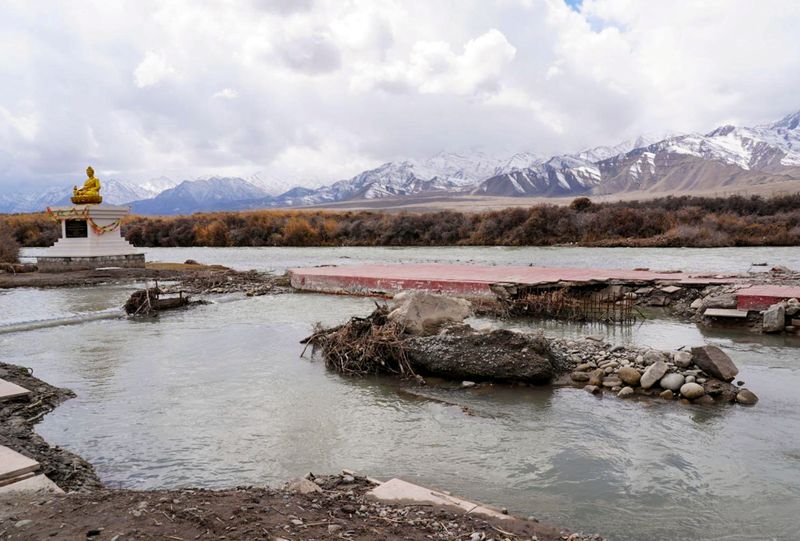
Flowing through the sacred land of Ladakh, the river today remains a living symbol of India’s cultural continuity. It is not merely a stream of water, but the flowing consciousness of a timeless civilisation that once guided the world. It is with the purpose of reconnecting people with this profound historical and spiritual heritage that the Sindhu Darshan Yatra was initiated.
In 1996, senior leader Lal Krishna Advani, during his visit to Ladakh, proposed the idea of reconnecting the Indian masses with the Indus River. Alongside him, noted journalist and thinker Tarun Vijay played a significant role in transforming this cultural initiative into a nationwide movement.
At that time, many people in the country were unaware that the “Sindhu” mentioned in the national anthem flowed through the Indian land of Ladakh itself. With this spirit, the Sindhu Darshan Yatra was launched, not merely as a religious event, but as an effort to bring India’s border regions into the center of national consciousness.
Former Prime Minister Atal Bihari Vajpayee later gave this movement a broader vision and national recognition. Vajpayee Ji was not just a statesman, but a visionary leader who deeply understood India’s cultural soul. He transformed Sindhu Darshan into a symbol of national unity and cultural renaissance.
In the year 2000, he inaugurated the Sindhu Darshan Festival and laid the foundation stone of the Sindhu Cultural Centre. He firmly believed that India’s true strength lies in its diversity and that cultural heritage such as the Sindhu, binds the nation emotionally.
Sindhu Mahakumbh holds a special emotional connection with the Sindhi community. After the Partition of 1947, Sindh became geographically separated from India, but the Indus River continues to remain the center of cultural memory and spiritual faith for the Sindhi people. For millions of displaced Sindhi families, Sindhu is not merely a river, but a symbol of identity, history, and ancestral roots. This is why Sindhi communities from across the country participate in the event with deep emotional reverence.
Sindhu Mahakumbh 2026 will truly embody the spirit of “Ek Bharat, Shreshtha Bharat.” Devotees from different states of India will bring sacred water from their respective rivers and offer it to the Sindhu in Leh. When the waters of the Ganga, Yamuna, Brahmaputra, Narmada, Godavari, Kaveri, and other sacred rivers merge into the Sindhu, the moment will stand as a powerful symbol of India’s cultural unity.
The event will extend far beyond religious rituals. Grand cultural performances, spiritual discourses, patriotic programs, folk arts, and special seminars on Indian civilisation will form an integral part of the Mahakumbh. Ladakhi folk dances, traditional music, Buddhist cultural presentations, yoga and meditation camps, handicraft exhibitions, and local cuisines will provide the festival with a truly multidimensional character.
Ladakh has, for centuries, remained a confluence of India’s spiritual traditions and cultural diversity. Its Buddhist heritage, peaceful monasteries, Himalayan way of life, and harmony with nature further enrich India’s civilizational ethos. Sindhu Mahakumbh will offer this heritage a renewed national and international recognition.
The event is also expected to significantly boost tourism and the local economy. Pilgrims and tourists from India and abroad will experience Ladakh’s natural beauty, cultural richness, and spiritual atmosphere. This, in turn, will benefit local handicrafts, hospitality, transport services, traditional products, and employment opportunities.
Extensive preparations are being undertaken by the administration of the Union Territory of Ladakh to ensure the grand and well-organised conduct of Sindhu Mahakumbh 2026. Under the guidance of Lieutenant Governor Vinai Kumar Saxena, efforts are being made toward the beautification of Sindhu Ghat, infrastructure development, lighting arrangements, cleanliness, security, traffic management, medical facilities, and visitor amenities. Special focus is being laid on accommodation, drinking water, parking facilities, emergency services, and information centres for pilgrims.
In addition, the active participation of religious organisations, social groups, local communities, and voluntary institutions is adding further grandeur to the event. The administration’s vision is not only to organise a successful festival, but to establish Sindhu Mahakumbh as a lasting symbol of India’s cultural identity.
Today, Sindhu Mahakumbh has emerged as a representation of an India that values its cultural roots as much as its modern aspirations. The event reminds us that India is not merely a geographical entity, but a living civilizational consciousness flowing uninterrupted for thousands of years.
When devotees, saints, artists, soldiers, Buddhist monks, members of the Sindhi community, and people from diverse cultures gather together on the banks of the Sindhu amidst the towering Himalayas, the sight will symbolise not only faith, but also the timeless cultural strength and unity of India.
Sindhu Mahakumbh 2026 is a celebration of that eternal Indian spirit which unites diversity, transcends boundaries, and inspires future generations to take pride in their civilisation and heritage.
The Sindhu, flowing through the lap of the Himalayas, seems to convey an eternal message even today:
Civilizations may change,
Time may change,
Boundaries may change,
But the cultural flow of India shall remain immortal forever.
( The Author can be reached at: tleh0007@gmail.com)