


Jammu and Kashmir, particularly the Kashmir Valley, is the largest producer, accounting for over 90% of India’s almond production
DR MEHRA-UD-DIN SHEIKH | DR MOHAMMED TAUSEEF ALI
Almonds (Prunus amygdalus) are often called nuts, but they are actually drupes, consisting of an outer fleshy part called a hull, a hard shell, and an inner seed that is often referred to as a kernel. Almonds are believed to be native to the Mediterranean and Central to Western Asia. Almonds belong to the family of “Rosaceae” and genus “Prunus.” Ripe almonds look like large green fruits and often split open by themselves, exposing the hard shell covering the seed, which is the edible part. Almonds are of two types, depending on the nature of the tree.
Sweet Almonds (Prunus amygdalus var. dulcis) – Sweet almond trees are grown for their edible seed. (ii) Bitter Almonds (Prunus amygdalus var. amara)—bitter almonds are grown for the bitter almond oil. Almonds are rich sources of protein, fibre, vitamin E, antioxidants, calcium, copper, magnesium and riboflavin. They are also a source of iron, potassium, zinc and the B vitamins niacin, thiamine and folate. A 30-gram serving has 13 g of healthy unsaturated fats and 1 g of saturated fat. Per 30-gram serving, almonds boast more vitamin E (7.7 mg), calcium (80 mg) and riboflavin (0.3 mg) than any other nut. Almonds also provide 6 grams of plant protein per 30-gram serving. Almonds are naturally salt-free/sodium-free and low in sugars.
Almonds are incredibly versatile in food preparation, finding their place in both sweet and savoury dishes. They can be enjoyed raw, roasted, or processed into various forms like almond flour, almond butter, or almond milk. Almonds are used as a snack, a topping, or an ingredient in everything from cookies, chocolates, candies, cakes, stir-fries, ice creams, etc. Almond cultivation in India is primarily concentrated in the mountainous regions of Jammu and Kashmir and Himachal Pradesh.
Jammu and Kashmir, particularly the Kashmir Valley, is the largest producer, accounting for over 90% of India’s almond production. Other states, such as Rajasthan, Madhya Pradesh, and Gujarat, are also looking into growing almonds in some of their best areas, but their contributions are very small. Almonds require a climate with slightly hot summer temperatures ranging from 30 to 35°C and cool winters for plant growth and kernel filling. Unopened blossoms shall withstand cold up to -2.2°C, but blossoms at the petal fall stage are damaged at 0.50°C to -1.1°C.
The blossoms can withstand temperatures ranging from -2.2°C to -3.3°C for a short time, but if low temperatures continue for long hours, they get damaged easily. It has a low winter chilling requirement of about 300 to 600 hours at or below 7°C. Because of this low chilling requirement (or short rest period) and the relatively low amount of heat, it brings the trees earlier into bloom; therefore, the almond is generally the earliest deciduous fruit or nut tree to flower, hence extremely vulnerable to frost injury where moderately late-spring frosts prevail.
Almonds need ample rainfall or irrigation water for maximum production of well-filled almond nuts. The almond tree has been successfully grown on a wide range of soils; however, sandy loams are best. It is a deeply rooted tree, and its performance is better in deep, fertile, and well-drained soils. Almond trees have high N and P requirements.
International and National scenario
The area under almonds in the world is 2.3 mha, whereas production is 3.5 million tonnes. In this, the USA is the largest contributor in production with 1.79 million tonnes, followed by Spain, Australia, Turkey, Morocco, Syria and so on (FAOSTAT, 2025). Therefore, the USA produces 51.14% of the world’s almond production in 2025. The California region of the USA dominates almond production.
At the national level, the area under almond is 10150 ha, and production is 11280 tonnes (National Horticulture data, 2021), for which J&K contributes dominantly over 90% and on which the Kashmir Valley contributes almost 99%. J&K and Himachal Pradesh have an area of 4.68 and 5.48 ha and production of 1.35 and 9.93 MT and productivity (t/ha) of 0.29 and 1.81, respectively (National Horticulture data, 2021).
The almond cultivation in the valley is mainly in the districts of Pulwama, Budgam, Srinagar, Baramulla and Srinagar, where production exceeds 552 tonnes annually. There are vast stretches of almond plantation in these areas, and most of them are on highlands locally called ‘karewas’. The altitude of the Kashmir Valley varies across areas, ranging from 1500 to 1850 m amsl. The mean annual precipitation of the Kashmir Valley is around 1000 mm.
Pulwama is the leading producer of almonds in the Union Territory (UT), with a production of 6468 metric tonnes (MT) in 2021–22, followed by Budgam (1940 MT), Baramulla (553 MT) and Srinagar (741 MT). Therefore, almost all of the production comes from the Kashmir Valley. The total area under UT is 5457 hectares (ha), and production is 9811 MT (Table).
The figure indicates that almond production in J&K is experiencing an overall declining trend. The land under almond cultivation was recorded as 17247 ha (2001-02), which has now reduced to 5457 ha (2021-22). J&K UT has lost a whopping 11,790 hectares of land that used to be under almond cultivation. The decline in the area under almond cultivation in the UT during 2014 and 2015 was mainly attributed to the incessant rainfall in September 2014, which caused damage to almond orchards due to waterlogging on Karewas.
| Table: District wise Area and production of Almonds in Jammu and Kashmir | ||
| Districts | Almonds | |
| Area (ha) | Production (MT) | |
| Pulwama | 3538 | 6468 |
| Budgam | 1249 | 1940 |
| Srinagar | 322 | 741 |
| Baramulla | 258 | 553 |
| Anantnag | 11 | 11 |
| Shopian | 7 | 13 |
| Ganderbal | 4 | 9 |
| Bandipora | 2 | 4 |
| Kulgam | 19 | 65 |
| Kupwara | 1 | 0 |
| Kathua | 10 | 6 |
| Doda | 24 | 1 |
| Udhampur | 12 | 0 |
| Total | 5457 | 9811 |
| Source: Directorate of Horticulture (2021-22) | ||
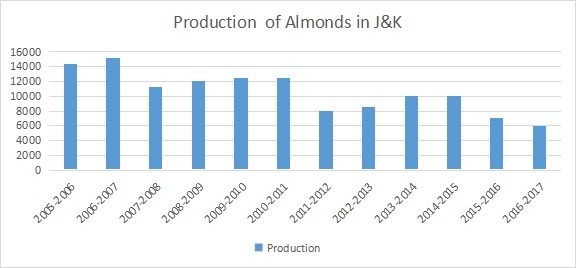
(Data source: Research paper of Wani et al., 2018, citing data of Directorate of Horticulture, J&K.)
Factors that lead to the decline of almond cultivation in Kashmir
Inclement weather: It is the main cause of the decline of almond area and production in the Valley. The inclement weather in the spring is responsible for the drastic drop in production. It is around mid-March every year when almonds start to bloom, and it lasts 10 to 15 days.
For several years, growers have faced inclement weather during March and April, which has led to a decline in almond production because they use indigenous varieties that bloom early and are susceptible to spring frost, injuring both the blossoms and the developing fruits. Untimely rains in the past have damaged the almond flower blossoms. Rains wash away the blossoms from the trees, affecting the overall fruit set of the crop.
Shift to apple cultivation: Kashmir Valley’s climate is ideal for apple cultivation and is more profitable than almond cultivation. Therefore, farmers prefer apple cultivation wherever water availability comes through technology; hence, a major reason farmers are shifting from almond to apple cultivation.
Low productivity, lack of new varieties and plant management: Farmers are using the old indigenous genotypes for almond production. Productivity of almonds in Kashmir is very low due to old and senile almond orchards with poor orchard floor, nutrient and canopy management practices. A survey of almond belts of the Kashmir Valley, covering the districts of Pulwama, Budgam, Srinagar and Anantnag, has revealed that more than 70 per cent of almond orchards have lived their economic age of 30-40 years.
No uniformity in produce: Most of the almond orchards are on seedlings, hence the diverse genotypes. Therefore, uniformity in kernel shape, size, and taste is impossible. The market has shifted towards uniform varieties, which has proven challenging for traditional almond cultivators who are unable to supply a particular type of almond in bulk quantities.
Low demand and price: Due to the import of Californian almonds in the Indian and international markets, almonds from Kashmir, which are smaller in size, darker in colour, wrinkled in surface, higher in oil content, and often of irregular shape, are facing competition.
Price-sensitive consumers find the imported almond prices attractive, particularly for California Nonpareil almonds, which are bigger, elongated and uniform in size and less oily. Intense competition from imported almonds has led to nosedive prices of Kashmiri almonds in Indian mandis and markets outside. Australian Nonpareil and Carmel varieties also account for a growing segment of the Indian market. Iranian varieties like Mamra and Qumi are popular in the western and northwestern regions of India (e.g. Rajasthan and Gujarat) and often get a price premium.
Porcupine attack on almond trees: Porcupines in Kashmir are damaging almond trees by peeling off their bark, which ultimately leads to tree death, particularly during the winter months when a shortage of food takes place. Human activities and climate change are responsible for this damage, forcing porcupines from their natural habitats into horticultural areas.
Import scenario: According to an Economic Times report of 2025, the United States supplies a significant portion of India’s almonds. Last year, almost 93% of India’s imports came from the US, valued at over $1 billion. Increased focus on health and rising incomes are driving demand for these dry fruits, outpacing domestic production and leading to more imports. The US Department of Agriculture estimates India’s almond import figure from August to July (2024-25) at 190,000 tonnes. Almond imports have increased by over 5.5 times since 2008.
Import duties: Import duties on USA almonds are meagre as of date at Rs. 35/kg for in-shell and Rs. 100/kg for kernels.
(To be continued…)
(Dr. Mehraj-Ud-Din Sheikh is presently working as Horticulture Development Officer, Directorate of Horticulture, Kashmir and can be reached at: shiekhmehraj10@gmail.com and Dr. Mohammed Tauseef Ali is presently working as an Assistant Professor of Horticulture Technology, J&K Higher Education and can be reached at: tauseefwani500@gmail.com)