

Shafat Malik
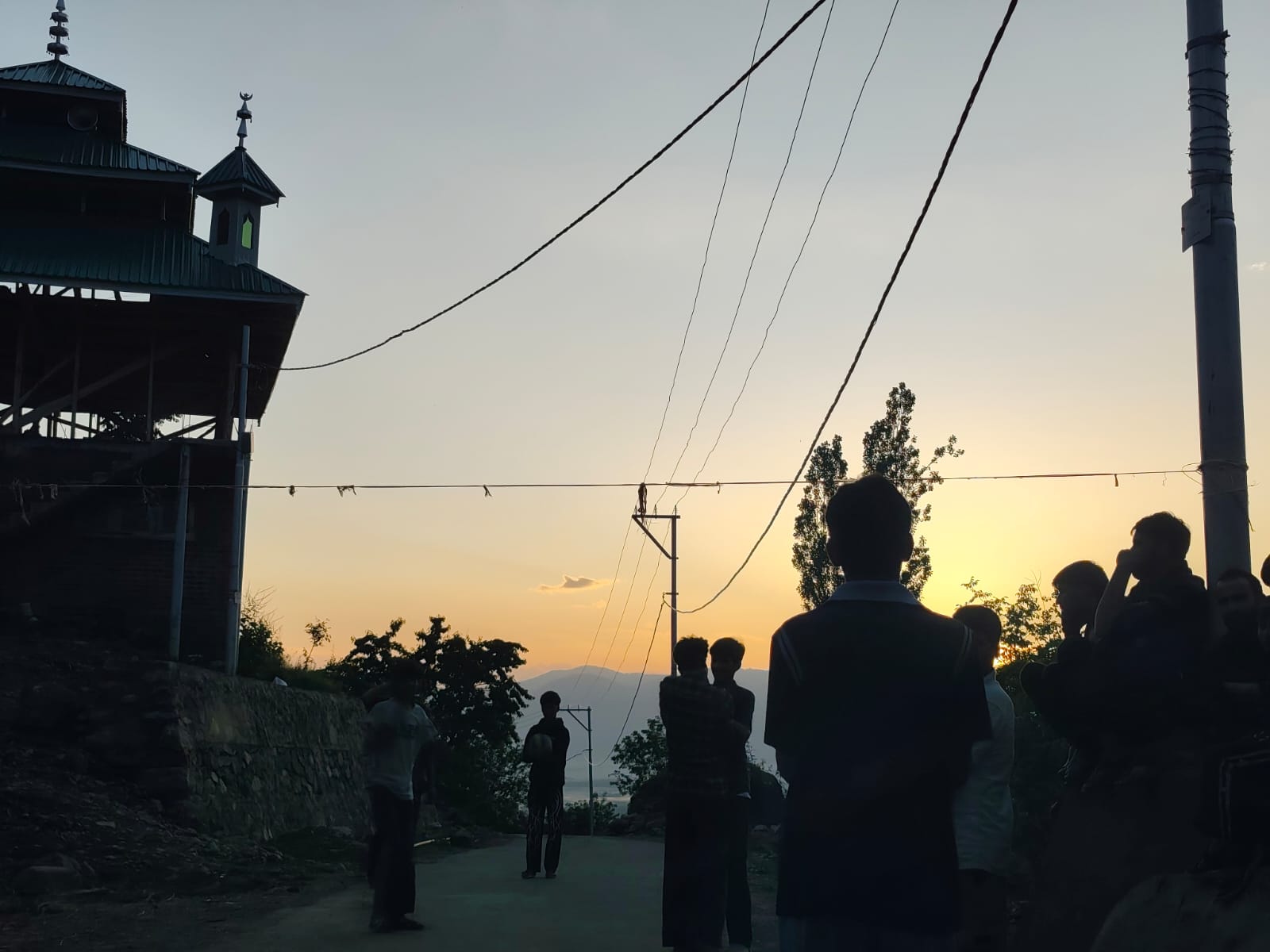
Bandipora, May 24: The net is a lie. What hangs between two wooden poles on a narrow road in the Chanpal area of Chittibanday in Bandipora is not a volleyball net but a single nylon rope, frayed at the edges, sagging in the middle, tied and retied so many times that the knots have become the only permanent thing here.
This rope is the court. These poles are the posts, and the road beneath them is where a generation of young men is learning to play a sport that this tiny pocket of Bandipora has loved for decades.
Chittibanday’s affair with volleyball is not new. It is not casual. For over twenty years, this area has produced players who have worn the Jammu & Kashmir state jersey at the national level. Some have represented India in age-group tournaments. Others have coached the next batch. Talent has never been the question. The ground has.
Until recently, the young men of Chanpal played on a private plot of land. A local farmer had allowed them, unofficially and quietly, to use his field as a makeshift court. There were no floodlights, no changing rooms, no proper lines. But there was space. A spike could be attempted without fear of hitting a passerby.
Then the permission was withdrawn.
“He denied us,” a local player told Rising Kashmir, his voice flat, stripped of anger. Not because there is no rage, but because he understands. The landowner has his reasons. Perhaps the crops were getting trampled. Perhaps the cattle were disturbed. Perhaps he simply grew tired of the noise. “It is his land,” the player added. “We cannot force him.”
But where does a volleyball player go when the only patch of earth that tolerated him says no?
In Chanpal, the answer is the road.
Every evening, as the light turns golden and the schoolchildren disperse, the rope is tightened. The players arrive. They have one ball. It is scuffed, its leather peeling, but it still flies. They divide into teams. The rules are the same as anywhere else. The difference is what surrounds them.
On one side, an orchard. On the other, a cluster of tin-roofed homes and in between, on the road, the game unfolds. A vehicle passes. They wait. A cow wanders onto the “court.” They shoo it away. A dive sends a player sliding into gravel. He gets up and raises his hand for the next serve.
An elderly former player – one of those who used to play in his 30s – stood at the edge of this road the other evening and watched. He did not smile. He did not scold. He simply looked at the rope and said, almost to himself: “We are not asking for an indoor stadium. Not for floodlights. Not even for a proper federation. Just a patch of land. Just a proper net. So the next national player doesn’t have to learn his jump serve with a vehicle coming toward him.”
That is the cruel mathematics of this story. An area that has given the state national-level volleyball players now has no place for its children to play. The talent is still here. The hunger is still here. But the ground is gone, replaced by a rope that snaps every few weeks and must be tied again.
In Chanpal, they have not stopped playing. But every dive is a risk. Every rally is interrupted, and every evening, the question hangs in the air, heavier than the sagging rope itself: How long can a champion village hold itself together with a single knot?