

Policy report by ARTO Srinagar calls for AI-driven enforcement, climate-resilient roads
Abid Bashir
Srinagar, May 12: A landmark policy report has raised serious concerns over growing pressure on Jammu & Kashmir’s transport and mobility systems, warning that climate vulnerability, security restrictions, weak public transport and seasonal tourism stress are increasingly affecting everyday civilian movement across the Union Territory.
The comprehensive report, accessed by Rising Kashmir, titled “Politics of Mobility in Jammu & Kashmir: Infrastructure, Security, Governance and Everyday Movement”, prepared by the Assistant Regional Transport Officer (ARTO) Er Mubashir Jan, is expected to be submitted to the J&K Transport Commissioner shortly for consideration.
The report presents mobility in J&K not merely as a transport issue, but as a deeply “political and strategic subject” closely linked to “security management, economic activity, governance, tourism and state-citizen relations.”
“Roads in J&K are not just transport corridors; they are economic lifelines, military supply routes, tourism pathways and instruments of governance,” the report states.
The study highlights how the region’s difficult geography, mountain ecology and prolonged security dynamics have created a unique transport environment where movement is regulated not only by infrastructure limitations but also by administrative controls and environmental vulnerabilities.
According to the report, National Highway-44 remains the Valley’s primary lifeline connecting Kashmir with Jammu and the rest of the country, while recent tunnel infrastructure and border road projects have significantly improved accessibility and reduced seasonal isolation.
“Balancing security imperatives with civilian convenience remains one of the biggest governance challenges in J&K,” the report observes.
The document also brings attention to the role of informal transport systems, particularly Tata Sumo taxis, minibuses and local shared transport operators that provide critical last-mile connectivity in rural and mountainous areas where formal transport systems remain limited.
While these services sustain livelihoods and regional movement, the report says they frequently operate under infrastructural stress, regulatory ambiguity and overloading risks.
On road safety, the report paints a worrying picture of overloaded freight vehicles, speeding on hill roads, unsafe passenger transport practices and inadequate emergency preparedness contributing to accident vulnerability across J&K.
It strongly recommends intelligent transport enforcement systems, including AI-based weigh-in-motion bridges, ANPR cameras, GPS-based vehicle monitoring and automated challan systems to improve road safety and governance.
The report also examines tourism-related mobility stress in major destinations such as Srinagar, Gulmarg, Sonamarg and Pahalgam, which witness massive seasonal congestion, parking shortages and environmental pressure during peak tourist periods.
To address this, the report advocates electric shuttle systems, regulated parking infrastructure, pedestrian-friendly zones and carrying-capacity management to ensure sustainable tourism growth without damaging fragile ecosystems.
Climate change and environmental vulnerability emerge as central concerns throughout the report.
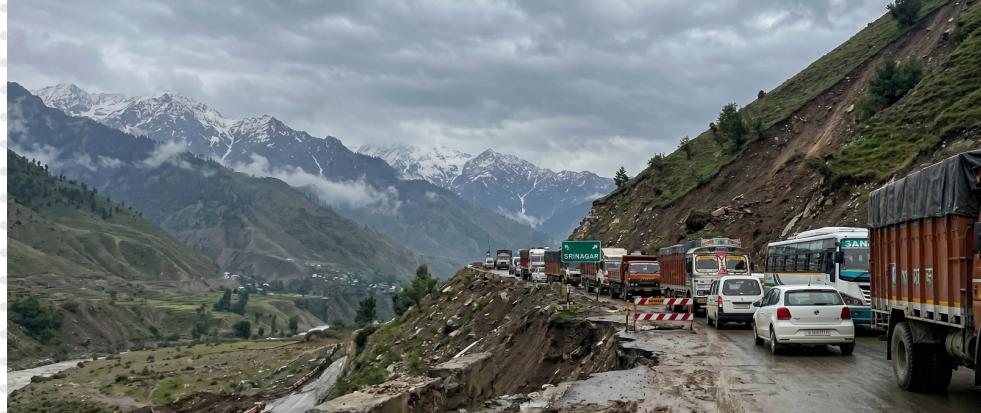
Referring to recurring landslides, floods, avalanches and snowfall disruptions — including the devastating 2014 floods — the report warns that transport infrastructure across Jammu & Kashmir remains highly vulnerable to extreme weather events.
It calls for climate-resilient engineering standards, intelligent drainage systems, slope stabilisation measures and stronger disaster-response logistics to prevent prolonged road closures and regional isolation.
The report also highlights gender-related mobility challenges, stating that women in many areas continue to face safety concerns, inadequate public transport and restricted night-time mobility.
It recommends gender-sensitive transport planning aimed at improving educational access, workforce participation and inclusive urban mobility systems.
In another significant observation, the document analyses the increasing role of digital mobility governance, including GPS navigation, online transport services, logistics systems and emergency communication networks. The report concludes with a strong call for integrated transport governance in Jammu & Kashmir through institutional coordination, public participation and technology-driven planning.
Speaking to Rising Kashmir, ARTO Srinagar Er Mubashir Jan said the report aims to contribute to long-term policy thinking on mobility governance and sustainable transport systems in Jammu & Kashmir.
“The future of mobility in J&K depends on resilient, equitable and technologically advanced transport systems that can balance security, environmental sustainability and civilian dignity,” he said, adding that the report would shortly be submitted to the Transport Commissioner for consideration.