

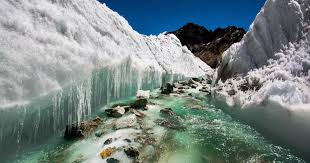
KU study links rising black carbon pollution to rapid melting of Himalayan ice reserves
Abid Bashir
Srinagar, May 20: The glaciers of Kashmir, long seen as the Valley’s frozen lifelines, are now melting under a growing layer of toxic soot, with scientists warning that pollution-driven warming is pushing the Himalayan region toward an unprecedented environmental crisis.
A major study conducted by researchers from University of Kashmir has revealed that black carbon pollution, commonly known as soot, is playing a dangerous role in accelerating glacier recession across Kashmir Himalaya, making the region’s glaciers retreat faster than many other glaciers spread across the Himalayan arc.
The study, authored by glaciologists Irfan Rashid, Tariq Abdullah and noted climate scientist Professor Shakil Ahmad Romshoo, examined nine glaciers over nearly three decades from 1992 to 2020 using satellite imagery, field observations and atmospheric modelling techniques.
What emerged from the research is a troubling portrait of mountains under siege.
The study found that the glaciers lost an average of 20.8 per cent of their total area during the study period, while glacier snouts retreated at nearly 14 metres annually. Scientists say such rapid recession signals a deepening climate imbalance unfolding across the Kashmir Himalaya.
However, beyond rising temperatures and changing snowfall patterns, researchers identified black carbon as a major accelerator of glacier melt.
Black carbon consists of microscopic soot particles released from diesel vehicles, brick kilns, industrial emissions, biomass burning, forest fires and fossil fuel combustion. Once released into the atmosphere, these particles travel long distances before settling on snow and glacier surfaces.
Normally, fresh snow reflects a large amount of incoming sunlight back into the atmosphere. But when black soot settles on the snow, it darkens the glacier surface, reducing its reflectivity — a process known as albedo reduction. As a result, glaciers absorb more solar heat and begin melting at much faster rates.
In simple terms, the cleaner the snow, the slower the melt. The darker the ice becomes, the faster it disappears.
The Kashmir University study recorded black carbon concentrations ranging between 500 and 1364 nanograms per cubic metre around glacier sites, with an average concentration of 842 ng m−3. Researchers noted that these levels are among the highest ever documented in the Himalayan and Tibetan Plateau regions.
Scientists say such exceptionally high concentrations are alarming because they indicate that pollution is now directly interacting with fragile high-altitude cryospheric systems.
The study also traced how polluted air reaches Kashmir’s glaciers.
Using NOAA’s HYSPLIT backward trajectory atmospheric model, researchers discovered that air masses carrying particulate pollution travel predominantly through powerful westerly winds into the Kashmir Himalaya. The southwest monsoon was also found contributing to pollutant transport, though to a lesser extent.
This means Kashmir’s glaciers are not only suffering from local pollution generated within the Valley but are also receiving atmospheric pollutants transported from distant regions.
Researchers observed that glaciers situated at lower elevations were receding much faster compared to glaciers located higher in the mountains. Glaciers lying at lower mean elevations recorded recession rates touching nearly 22 per cent, highlighting the growing vulnerability of mid-altitude Himalayan glaciers in a warming climate.
The study further revealed surprising findings regarding debris-covered glaciers.
Traditionally, debris layers on glaciers were believed to provide some insulation against melting. But in Kashmir, glaciers covered with debris showed significantly higher recession rates compared to cleaner glaciers. Debris-covered glaciers experienced nearly 39 per cent loss, while clean glaciers recorded only about 1.48 per cent recession.
Scientists believe uneven debris thickness may actually trap and absorb heat, intensifying glacier melt instead of protecting the ice.
The implications of accelerated glacier retreat extend far beyond the mountains.
Kashmir’s glaciers serve as natural freshwater reservoirs feeding rivers, streams, wetlands and springs that sustain agriculture, hydropower projects and drinking water supplies for millions of people downstream. Rapid glacier melt could initially increase the risk of flash floods, glacial lake outburst floods and erratic river flows. But in the long run, shrinking glaciers may drastically reduce water availability across the region.
Researchers have stressed the urgent need for permanent black carbon and dust monitoring stations across glacier regions to generate long-term scientific data on pollution trends and glacier health.
The study ultimately delivers a stark warning–climate change may be warming the Himalayas, but toxic soot is acting like an accelerant — speeding up the collapse of Kashmir’s glaciers and threatening the ecological future of the Valley itself.