

‘Rapid depletion could alter hydrological systems, impact agri, drinking water’
Abid Bashir
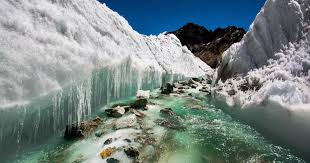
Srinagar, May 19: A major study conducted by researchers from the University of Kashmir has revealed that Kashmir’s smaller glaciers are melting at an alarming pace, exposing a silent but accelerating climate crisis unfolding in the Himalayas.
The research, based on multi-temporal Landsat satellite imagery spanning more than three decades, found that glaciers smaller than one square kilometre are retreating much faster than larger glaciers, making them among the most vulnerable components of Kashmir’s mountain ecosystem.
According to the KU study, the total glacier area of nine benchmark glaciers in the Lidder Valley reduced from 29.01 square kilometres in 1980 to 23.81 square kilometres in 2013, reflecting a deglaciation of nearly 18 per cent in just 33 years.
However, scientists said the most worrying trend emerged among the Valley’s smaller glaciers.
The study found that glaciers measuring less than one square kilometre lost nearly 25 per cent of their total area during the observation period, while medium-sized glaciers lost around 23 percent and larger glaciers recorded comparatively lower recession rates.
“The smaller glaciers are under greater threat because they respond much faster to climate variations,” the KU study observed, noting that glacier thickness and size directly influence their survival capacity under warming conditions.
Researchers explained that shrinking glaciers are not merely indicators of rising temperatures but also warning signals for Kashmir’s long-term water security.
“These glaciers act as natural freshwater reservoirs feeding rivers and streams across the Valley. Their rapid depletion could alter hydrological systems and impact agriculture, irrigation and drinking water availability,” the study warned.
The famous Kolahoi Glacier — considered Kashmir’s largest glacier — was also found to be retreating steadily.
According to the study, Kolahoi Glacier shrank from 13.57 square kilometres in 1980 to 11.24 square kilometres in 2013, losing more than 2.3 square kilometres of ice cover.
Researchers observed that both snouts of the glacier are moving upward, indicating continuous retreat driven by changing climatic conditions.
The KU researchers also studied glacier dynamics, including accumulation area ratio (AAR), equilibrium line altitude (ELA), slope orientation and glacier geometry, to understand why some glaciers are melting faster than others.
The findings showed that south-facing glaciers are experiencing the highest melt rates because of increased exposure to sunlight. These glaciers lost nearly 31 per cent of their area during the study period.
In contrast, north-east-facing glaciers showed relatively lower recession rates.
Scientists further observed a continuous decline in glacier accumulation zones — the regions where snowfall gathers and sustains glacier growth.
“Reduction in accumulation areas means glaciers are receiving less snow replenishment while melting continues at a faster pace,” experts explained.
The study also highlighted the growing role of rising temperatures, black carbon deposition and anthropogenic activities in accelerating glacier retreat across the Himalayas.
Researchers noted that temperatures in the Kashmir Himalayas are projected to rise sharply by the end of the century, potentially intensifying glacier melt in the coming decades.
Experts said remote sensing and satellite technology have become essential tools for glacier monitoring in the Himalayas, where direct field measurements remain extremely difficult because of rugged terrain and harsh weather conditions.
Environmental observers warned that the disappearance of Kashmir’s smaller glaciers may trigger long-term ecological and hydrological consequences that are still poorly understood.
“What is happening in Kashmir’s mountains today is a warning from the future,” experts said. “The glaciers are shrinking quietly, but the impacts could eventually reach every household dependent on Himalayan water systems.”